Minor Arcana guide
Two of Swords Meaning
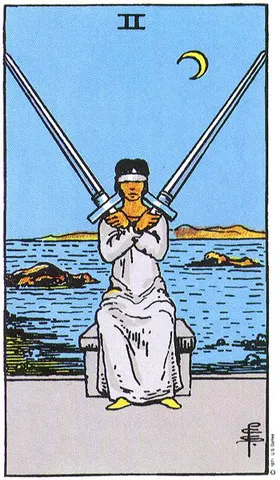
A seated, blindfolded figure balances two blades beneath a crescent moon. This is a deliberate pause between claims, often chosen to preserve fragile peace. The balance is active, not effortless: avoiding a choice also shapes what happens next.
Read the guideBy Moonletter · Updated
A way to read it
Upright: A difficult choice
Upright, it points to a stalemate, guardedness, or a decision made difficult by incomplete information. You may be trying to hear both sides before committing. Set a time to revisit the question and identify which fact, conversation, or value would actually change your view.
A way to read it
Reversed meaning
Reversed, the truce may be breaking, or the effort to keep everything even may conceal a preference. It can also suggest that new information makes a decision possible. Name the trade-off plainly; do not call indecision neutrality when it protects one side more than another.
Love and relationships
Use these themes alongside actual communication; a card cannot establish another person’s private feelings.
If single
In dating, this card can describe uncertainty about whether to engage, disclose a preference, or choose between possibilities. Avoid keeping people in ambiguity merely to avoid discomfort. A respectful answer, including “I need more time,” is clearer than silent testing.
In a relationship
Partners may be postponing a difficult but manageable decision. Each person can state what they fear losing and what information they lack, then agree on a date to decide. A pause helps only when both understand its purpose and limits.
As feelings
The blindfold is not evidence about someone’s feelings. It may symbolize your uncertainty, a person’s privacy, or a conversation neither has started. Interest, restraint, and confusion are all possible; ask directly and avoid treating a guessed motive as fact.
Reversed in love
Reversed in love, avoidance can turn into mixed signals or a sudden argument. Choose one concrete topic and speak without demanding an immediate emotional verdict. If the other person declines the conversation, respect that boundary and decide what you need for yourself.
Career and work
At work, the card suits competing priorities: two deadlines, teams, or proposals that cannot both receive full attention. Make constraints visible and ask who owns the decision. For example, compare the cost of delaying each launch rather than pretending both can be finished unchanged.
Reversed in career
Reversed, a quiet disagreement may be leaking into missed handoffs or inconsistent decisions. Surface the point of difference and record the chosen priority. A manager should invite dissent before closure, then make ownership and next review explicit.
Future position
In a future position, the Two asks you to notice a coming choice that may require a pause for evidence or a candid conversation. It forecasts no stalemate or outcome. Decide what would count as enough information, and when waiting stops being useful.
Reading the position
Treat this as a possible developing theme and look for real evidence that supports the interpretation, rather than a guaranteed event.
Yes or no
Editorially, this is a conditional answer: yes to a bounded pause or balanced review, no to indefinite avoidance. If the question is whether both options are equally safe, the card cannot establish that. Compare real consequences before deciding.
An editorial convention
Yes/no labels are not a universal tarot standard. This guide uses them as reflection prompts, not as factual answers or a substitute for important decisions.
Try a reflection exercise
Draw two columns for the options. In each, record one benefit, one cost, and one fact you still need. Circle the fact that could change the choice, then set a date to obtain it. This is a modern reflection exercise.
About this exercise
This is a Moonletter editorial exercise, not an instruction from the historical source.
Imagery and symbolism
Waite’s image shows a blindfolded woman balancing swords on her shoulders; he notes qualified harmony, courage, friendship, or intimacy, and a reversed reading of duplicity. The moon and covered eyes invite attention to partial knowledge, while the blades show that the balance requires effort.
Two of Swords vs Ace of Swords
Ace of Swords cuts through ambiguity with a stated claim; the Two holds two claims in tension and asks what evidence or value can guide a choice.
Sources and interpretation
Historical imagery is referenced against A. E. Waite’s The Pictorial Key to the Tarot, Part III (public text on Wikisource). Modern relationship and work applications and exercises are editorial interpretations. Tarot symbolism is not scientific evidence about future events or another person’s thoughts.
Take the question one step further
Bring your own context
Use this as a learning prompt about the card. It is not a real draw or a prediction.
Ask the assistantA few clear answers
Questions people ask
What does the Two of Swords mean?
A seated, blindfolded figure balances two blades beneath a crescent moon. This is a deliberate pause between claims, often chosen to preserve fragile peace. The balance is active, not effortless: avoiding a choice also shapes what happens next.
What does the Two of Swords reversed mean?
Reversed, the truce may be breaking, or the effort to keep everything even may conceal a preference. It can also suggest that new information makes a decision possible. Name the trade-off plainly; do not call indecision neutrality when it protects one side more than another.
What does the Two of Swords mean in love?
Partners may be postponing a difficult but manageable decision. Each person can state what they fear losing and what information they lack, then agree on a date to decide. A pause helps only when both understand its purpose and limits.
Is the Two of Swords a yes or no?
Editorially, this is a conditional answer: yes to a bounded pause or balanced review, no to indefinite avoidance. If the question is whether both options are equally safe, the card cannot establish that. Compare real consequences before deciding.