Minor Arcana guide
Ace of Swords Meaning
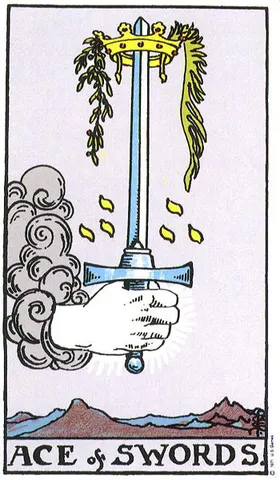
A hand emerging from a cloud raises a sword crowned with a wreath. The Ace is the first clear thought that cuts through noise: a question named honestly, a boundary stated plainly, or an idea ready to be tested. Its force can clarify or wound, so precision matters as much as courage.
Read the guideBy Moonletter · Updated
A way to read it
Upright: Clarity and a new idea
Upright, it favors discernment, direct communication, and a decisive beginning. You might finally distinguish a repeated assumption from evidence, or find the words to ask for a fair agreement. The card does not promise victory; it asks you to define the claim, check the facts, and use clarity responsibly.
A way to read it
Reversed meaning
Reversed, a sharp idea may be premature, confused, or used as a weapon. Contradictory messages, brittle certainty, or an argument won at the cost of trust can all fit. Slow the exchange: restate what you heard, separate observation from interpretation, and correct the record before making a consequential choice.
Love and relationships
Use these themes alongside actual communication; a card cannot establish another person’s private feelings.
If single
In dating, the Ace supports an honest opening: say what kind of connection you want, ask a direct question, or clarify a boundary. A candid exchange can reveal compatibility, but a clever message cannot manufacture mutual interest. Let the other person answer freely and take the answer as information.
In a relationship
For partners, use this card to bring one unresolved subject into the open without turning the talk into a trial. Name the concrete event, its impact, and the change you are requesting. Clarity can restore coordination; it cannot substitute for listening, repair, or agreement from both people.
As feelings
This card cannot establish another person’s private thoughts. It can invite a possibility of frank interest, a wish to define the connection, or a need to speak honestly; it can also reflect your own hope for certainty. Look to consistent words and behavior, and ask rather than treating a symbol as proof.
Reversed in love
Reversed in love, a conversation may be tangled in assumptions, defensiveness, or language that cuts. Avoid sending a message while angry or treating silence as a complete explanation. Write down the question you truly need answered, choose a calm moment, and allow the other person to disagree or decline.
Career and work
At work, the Ace can mark a proposal, a useful insight, or a decision that depends on accurate language. Before presenting a plan, state the problem, evidence, options, and measure of success. For example, turn “sales are weak” into a specific segment and period to investigate. Keep a record of the decision.
Reversed in career
Reversed, unclear scope or overconfident claims can derail a project. A team may use the same word for different outcomes, or a polished argument may hide missing data. Ask each stakeholder to define the terms, check the source, and reduce the claim to what the evidence actually supports.
Future position
In a future position, treat the Ace as a prompt to prepare for a moment when clear thinking or honest speech may matter. It does not predict a revelation, win, or fixed event. Consider what information you would need, what question you can ask, and how you could communicate without overstating what you know.
Reading the position
Treat this as a possible developing theme and look for real evidence that supports the interpretation, rather than a guaranteed event.
Yes or no
As an editorial yes-or-no convention, this leans yes for asking a clear question, gathering evidence, or beginning a conversation. It leans no for acting on an untested accusation or assuming that forceful wording guarantees success. The card calls for a truthful basis; it is not permission from fate.
An editorial convention
Yes/no labels are not a universal tarot standard. This guide uses them as reflection prompts, not as factual answers or a substitute for important decisions.
Try a reflection exercise
Describe the decision in one neutral sentence. List three verified facts, two assumptions, and one missing fact. Draft a question to resolve the most important gap. This is an editorial reflection prompt, not a ritual or a claim from Waite.
About this exercise
This is a Moonletter editorial exercise, not an instruction from the historical source.
Imagery and symbolism
Waite describes a hand from cloud grasping a crowned sword, linking it with force. This guide reads the crown as authority requiring accountability.
Ace of Swords vs Two of Swords
Two of Swords holds competing claims in suspension; the Ace gives one claim a name and asks whether it is sound.
Sources and interpretation
Historical imagery is referenced against A. E. Waite’s The Pictorial Key to the Tarot, Part III (public text on Wikisource). Modern relationship and work applications and exercises are editorial interpretations. Tarot symbolism is not scientific evidence about future events or another person’s thoughts.
Take the question one step further
Bring your own context
Use this as a learning prompt about the card. It is not a real draw or a prediction.
Ask the assistantA few clear answers
Questions people ask
What does the Ace of Swords mean?
A hand emerging from a cloud raises a sword crowned with a wreath. The Ace is the first clear thought that cuts through noise: a question named honestly, a boundary stated plainly, or an idea ready to be tested. Its force can clarify or wound, so precision matters as much as courage.
What does the Ace of Swords reversed mean?
Reversed, a sharp idea may be premature, confused, or used as a weapon. Contradictory messages, brittle certainty, or an argument won at the cost of trust can all fit. Slow the exchange: restate what you heard, separate observation from interpretation, and correct the record before making a consequential choice.
What does the Ace of Swords mean in love?
For partners, use this card to bring one unresolved subject into the open without turning the talk into a trial. Name the concrete event, its impact, and the change you are requesting. Clarity can restore coordination; it cannot substitute for listening, repair, or agreement from both people.
Is the Ace of Swords a yes or no?
As an editorial yes-or-no convention, this leans yes for asking a clear question, gathering evidence, or beginning a conversation. It leans no for acting on an untested accusation or assuming that forceful wording guarantees success. The card calls for a truthful basis; it is not permission from fate.