Minor Arcana guide
Two of Wands Meaning
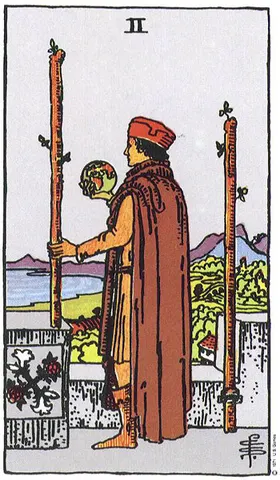
The Two of Wands turns a private possibility into a plan. A figure holds a globe while looking beyond a fortified height: the world is imaginable, yet the next move still belongs to the person holding it. It asks how to turn ambition into choice.
Read the guideBy Moonletter · Updated
A way to read it
Upright: Planning and foresight
Upright, it points to planning, a wider horizon, and the confidence to compare options before committing. You may have resources or a stable base, but expansion requires a real decision: which market, route, project, or life direction deserves your time? Pair ambition with preparation.
A way to read it
Reversed meaning
Reversed, the card can describe hesitation, fear of the unknown, or a plan that has become too narrow to move. You may keep rehearsing outcomes without testing one. It can also show a surprising change that unsettles your assumptions.
Love and relationships
Use these themes alongside actual communication; a card cannot establish another person’s private feelings.
If single
For a single person, this card often describes looking outward and deciding what kind of connection fits the life you are building. You may be curious about someone at a distance or weighing whether to make room for dating. It favors intentional exploration over assuming that desire alone guarantees a meeting.
In a relationship
In a relationship, the Two invites a shared conversation about direction: where to live, how to balance independence, or what a mutual future should include. It can prompt you to check whether you are planning together or holding different ideas of the future.
As feelings
Feelings may be present but still under evaluation. Someone can be interested and also cautious, considering timing, distance, or the consequences of getting closer. A globe held in the hand suggests possibility, not possession: attraction may be real while the choice to act remains open.
Reversed in love
Reversed in love, the card can point to avoidance of a necessary conversation, fear of commitment, or plans made without checking the other person’s wishes. Pause the imagined future and ask what is actually known. If a sudden shift occurs, respond to what was said and done rather than building a story around it.
Career and work
At work, this is a strategy card: assess the next territory before scaling. A founder might compare two distribution channels; an employee might map the skills and salary range needed for a move. Gather evidence, set a decision date, and identify what you can test cheaply before making a large commitment.
Reversed in career
Reversed, career planning may be stuck in comparison or overconfidence. A polished expansion plan can still fail if it ignores time, cash, or the people who must carry it out. Reduce the decision to one testable next step, and ask a trusted colleague to challenge the assumptions rather than merely approve the ambition.
Future position
In a future-position reading, the Two invites you to examine a coming choice or planning decision. Progress may depend on selecting a direction rather than waiting for perfect certainty. Compare what you know about each option and choose a small test before committing; the position offers no fixed deadline or guaranteed outcome.
Reading the position
Treat this as a possible developing theme and look for real evidence that supports the interpretation, rather than a guaranteed event.
Yes or no
As an editorial yes-or-no convention, this is a conditional yes for a question about exploring a well-prepared opportunity. The answer leans no if the question asks whether to leap without a plan. The card’s emphasis is choice and foresight, so define the risk you can accept before treating it as approval.
An editorial convention
Yes/no labels are not a universal tarot standard. This guide uses them as reflection prompts, not as factual answers or a substitute for important decisions.
Try a reflection exercise
Write two plausible next paths on separate pages. For each, list one benefit, one cost, one fact you need, and a small experiment you could finish this week. Choose a date to review the evidence. This exercise turns distant ambition into a decision you can inspect.
About this exercise
This is a Moonletter editorial exercise, not an instruction from the historical source.
Imagery and symbolism
The globe suggests a broad field of possibility; the height suggests perspective and a protected starting point. One wand is held and another is fixed, evoking agency alongside existing commitments. Historical descriptions include grandeur and sorrow; this is not effortless success.
Two of Wands vs Ace of Wands
Ace of Wands marks the first spark of a project; the Two asks what direction that spark should take.
Sources and interpretation
Historical imagery is referenced against A. E. Waite’s The Pictorial Key to the Tarot, Part III (public text on Wikisource). Modern relationship and work applications and exercises are editorial interpretations. Tarot symbolism is not scientific evidence about future events or another person’s thoughts.
Take the question one step further
Bring your own context
Use this as a learning prompt about the card. It is not a real draw or a prediction.
Ask the assistantA few clear answers
Questions people ask
What does the Two of Wands mean?
The Two of Wands turns a private possibility into a plan. A figure holds a globe while looking beyond a fortified height: the world is imaginable, yet the next move still belongs to the person holding it. It asks how to turn ambition into choice.
What does the Two of Wands reversed mean?
Reversed, the card can describe hesitation, fear of the unknown, or a plan that has become too narrow to move. You may keep rehearsing outcomes without testing one. It can also show a surprising change that unsettles your assumptions.
What does the Two of Wands mean in love?
In a relationship, the Two invites a shared conversation about direction: where to live, how to balance independence, or what a mutual future should include. It can prompt you to check whether you are planning together or holding different ideas of the future.
Is the Two of Wands a yes or no?
As an editorial yes-or-no convention, this is a conditional yes for a question about exploring a well-prepared opportunity. The answer leans no if the question asks whether to leap without a plan. The card’s emphasis is choice and foresight, so define the risk you can accept before treating it as approval.