Minor Arcana guide
Three of Swords Meaning
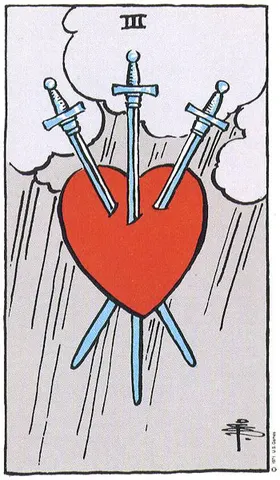
Heartbreak, sorrow, and a difficult truth are at the center of the Three of Swords. Three blades pierce a heart beneath cloud and rain, giving emotional pain or separation a stark image. The card does not predict death, illness, or pregnancy loss; it names hurt without claiming that sorrow is permanent.
Read the guideBy Moonletter · Updated
A way to read it
Upright: Heartache and difficult truth
Upright, acknowledge the wound before demanding a lesson from it. A breakup, exclusion, or disappointing answer may need time and an honest account of what happened. Separate the pain of the event from conclusions such as “I will always be rejected.”
A way to read it
Reversed meaning
Reversed, pain may be easing, being avoided, or returning in an unresolved conversation. None of these is guaranteed. Notice whether you can name what still hurts and what support or boundary would help; do not force forgiveness or treat emotional recovery as a deadline.
Love and relationships
Use these themes alongside actual communication; a card cannot establish another person’s private feelings.
If single
For someone dating, the card may reflect disappointment, rejection, or caution after a prior hurt. Let one person’s response be about this interaction rather than a verdict on your worth. Take space if needed, and keep expectations proportionate to what has actually developed.
In a relationship
In a partnership, a painful subject may need acknowledgment before problem-solving. Describe the impact without exaggerating intent, then ask what repair would look like to each person. The card does not say a relationship must end; the next step depends on safety, willingness, and conduct.
As feelings
The card cannot read another person’s mind. It may mirror grief, regret, empathy, or fear in you, while another person could feel something different. If you need to know, ask with room for an honest answer rather than assuming the image confirms their remorse.
Reversed in love
Reversed in love, a wound may be minimized or repeatedly reopened by blame. Pause before revisiting the same dispute; identify the specific repair requested and whether both people consent to try. If contact is unwanted, respect the boundary rather than using closure as a reason to press.
Career and work
At work, this can mark disappointing feedback, a lost proposal, or tension after a decision. Let the disappointment register, then extract the actionable point: which requirement was unmet, what can be changed, and what is outside your control? Do not turn one setback into a forecast of career failure.
Reversed in career
Reversed, unresolved hurt may distort collaboration or make feedback hard to hear. Ask for concrete examples and respond after reflection. A team can acknowledge impact without assigning total blame; document agreed changes and check whether the new process reduces repeat friction.
Future position
In a future position, use the Three as a reminder to make room for honest emotional responses if a difficult conversation or disappointment arises. It does not predict a breakup or tragedy. You can prepare supportive people, clear boundaries, and a pause before replying.
Reading the position
Treat this as a possible developing theme and look for real evidence that supports the interpretation, rather than a guaranteed event.
Yes or no
Editorially, the answer is not a fixed yes or no. It leans toward pausing if the question asks whether to ignore a hurt or rush reconciliation; it may support a candid conversation when the goal is understanding. The card cannot decide what another person will do.
An editorial convention
Yes/no labels are not a universal tarot standard. This guide uses them as reflection prompts, not as factual answers or a substitute for important decisions.
Try a reflection exercise
Take five quiet minutes and write three lines: what happened, what I felt, and what I need next. Circle any guess about another person’s motive and turn it into an observable fact or a question. Choose one small next step, such as asking for a conversation or taking space. Stop if writing feels overwhelming; this original reflection prompt is not clinical care.
About this exercise
This is a Moonletter editorial exercise, not an instruction from the historical source.
Imagery and symbolism
Waite describes three swords piercing a heart beneath cloud and rain, with meanings around absence, delay, division, and rupture. The modern reading treats the image as a metaphor for hurt, not a literal prediction. Rain can also suggest that an emotional state moves and changes.
Three of Swords vs Two of Swords
Two of Swords holds a conflict in suspension; the Three shows the hurt that may need naming once the tension becomes personal.
Sources and interpretation
Historical imagery is referenced against A. E. Waite’s The Pictorial Key to the Tarot, Part III (public text on Wikisource). Modern relationship and work applications and exercises are editorial interpretations. Tarot symbolism is not scientific evidence about future events or another person’s thoughts.
Take the question one step further
Bring your own context
Use this as a learning prompt about the card. It is not a real draw or a prediction.
Ask the assistantA few clear answers
Questions people ask
What does the Three of Swords mean?
Heartbreak, sorrow, and a difficult truth are at the center of the Three of Swords. Three blades pierce a heart beneath cloud and rain, giving emotional pain or separation a stark image. The card does not predict death, illness, or pregnancy loss; it names hurt without claiming that sorrow is permanent.
What does the Three of Swords reversed mean?
Reversed, pain may be easing, being avoided, or returning in an unresolved conversation. None of these is guaranteed. Notice whether you can name what still hurts and what support or boundary would help; do not force forgiveness or treat emotional recovery as a deadline.
What does the Three of Swords mean in love?
In a partnership, a painful subject may need acknowledgment before problem-solving. Describe the impact without exaggerating intent, then ask what repair would look like to each person. The card does not say a relationship must end; the next step depends on safety, willingness, and conduct.
Is the Three of Swords a yes or no?
Editorially, the answer is not a fixed yes or no. It leans toward pausing if the question asks whether to ignore a hurt or rush reconciliation; it may support a candid conversation when the goal is understanding. The card cannot decide what another person will do.
Is the Three of Swords a bad card or proof of a breakup?
It is a difficult image associated with heartbreak and separation, but drawing it does not prove that a breakup, betrayal or other event will happen. Start with what has actually been said or done, name the hurt, and choose one respectful question or supportive next step.