Minor Arcana guide
Ten of Swords Meaning
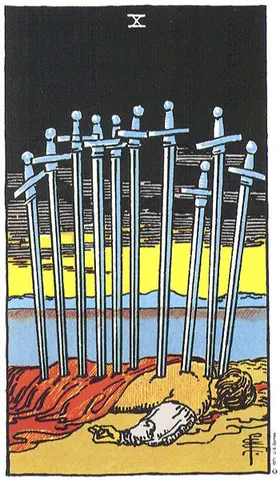
A figure lies beneath ten swords as dawn light appears on the horizon. The Ten depicts an ending, exhaustion, or the recognition that a strategy has run its course. Waite explicitly says it is not especially a card of violent death. Read it as a difficult image of closure, never a literal death forecast.
Read the guideBy Moonletter · Updated
A way to read it
Upright: An ending and its aftermath
Upright, face what has ended and stop investing in a version that no longer works. A project, expectation, or argument may require a clear closeout. The dawn matters: closure can create room for a next phase, but it does not promise immediate relief.
A way to read it
Reversed meaning
Reversed, recovery may be gradual, or an ending may be prolonged by trying to revive what is finished. Check whether the facts have changed. If not, decide what would make a respectful close possible and what lesson is useful without blaming yourself.
Love and relationships
Use these themes alongside actual communication; a card cannot establish another person’s private feelings.
If single
In dating, the Ten can reflect the end of an exchange or disappointment after hopes collapse. Do not use it to predict that a person will leave. If something has ended in observable words or actions, honor that boundary and give yourself space before pursuing another explanation.
In a relationship
Partners facing a major rupture can use this card to ask whether the current pattern is sustainable. It does not command separation. A repair attempt needs mutual willingness, concrete change, and respect for safety; either person may also decide the relationship has reached its end.
As feelings
This image cannot prove that someone feels defeated, betrayed, or finished with you. It may reflect your own sense of finality. Ask what has actually been communicated, and avoid interpreting a painful symbol as access to another person’s private decision.
Reversed in love
Reversed in love, the same conflict may be restarting without meaningful change, or healing may be under way. Name what would need to be different this time. If the answer is “nothing,” pause before re-entering a cycle that has repeatedly harmed you.
Career and work
At work, this may signal a failed launch, a role ending, or a project that needs an honest postmortem. Preserve useful records, state the outcome without blame, and identify what should stop, continue, or change. Ending work cleanly protects capacity for the next effort.
Reversed in career
Reversed, a team may be tempted to relaunch the same plan because the first ending feels uncomfortable. Require new evidence before restarting. If the situation is improving, define the small signs of recovery and keep the lessons visible.
Future position
In a future position, treat the Ten as a prompt to prepare for closure or a necessary change, not a prediction of catastrophe. Ask what you would want documented, who needs to be informed, and how to preserve dignity if a plan ends.
Reading the position
Treat this as a possible developing theme and look for real evidence that supports the interpretation, rather than a guaranteed event.
Yes or no
Editorially, this leans no to repeating a demonstrably failed approach without new evidence, and yes to completing an ending that is already clear. It cannot forecast death or disaster. The answer depends on observable conditions and what remains within your control.
An editorial convention
Yes/no labels are not a universal tarot standard. This guide uses them as reflection prompts, not as factual answers or a substitute for important decisions.
Try a reflection exercise
Write the title of one chapter that may be ending. List what is complete, what needs a practical handoff, and one thing you want to carry forward. Leave blank any conclusion you cannot yet know. This exercise is an editorial reflection.
About this exercise
This is a Moonletter editorial exercise, not an instruction from the historical source.
Imagery and symbolism
Waite describes a prostrate figure pierced by the card’s swords and associates it with pain, affliction, sadness, and desolation, while specifying that it is not especially a violent-death card. This guide foregrounds that distinction and reads the dawn as an image of possible continuation, not guaranteed success.
Ten of Swords vs Nine of Swords
Nine of Swords centers worry and troubled thought; Ten of Swords marks a perceived ending or limit, with the horizon suggesting that another phase may follow.
Sources and interpretation
Historical imagery is referenced against A. E. Waite’s The Pictorial Key to the Tarot, Part III (public text on Wikisource). Modern relationship and work applications and exercises are editorial interpretations. Tarot symbolism is not scientific evidence about future events or another person’s thoughts.
Take the question one step further
Bring your own context
Use this as a learning prompt about the card. It is not a real draw or a prediction.
Ask the assistantA few clear answers
Questions people ask
What does the Ten of Swords mean?
A figure lies beneath ten swords as dawn light appears on the horizon. The Ten depicts an ending, exhaustion, or the recognition that a strategy has run its course. Waite explicitly says it is not especially a card of violent death. Read it as a difficult image of closure, never a literal death forecast.
What does the Ten of Swords reversed mean?
Reversed, recovery may be gradual, or an ending may be prolonged by trying to revive what is finished. Check whether the facts have changed. If not, decide what would make a respectful close possible and what lesson is useful without blaming yourself.
What does the Ten of Swords mean in love?
Partners facing a major rupture can use this card to ask whether the current pattern is sustainable. It does not command separation. A repair attempt needs mutual willingness, concrete change, and respect for safety; either person may also decide the relationship has reached its end.
Is the Ten of Swords a yes or no?
Editorially, this leans no to repeating a demonstrably failed approach without new evidence, and yes to completing an ending that is already clear. It cannot forecast death or disaster. The answer depends on observable conditions and what remains within your control.