The foundations around a long-term choice
Ten of Pentacles Meaning
The Ten of Pentacles represents lasting security, shared resources and the family or community structures built over time. Upright, it emphasizes continuity and support; reversed, it can point to conflicting expectations or an unstable foundation. In love and career, the central question is what makes a shared future sustainable. It does not guarantee wealth, marriage or job security.
Read the guideA way to read it
Upright: look at the larger structure
Upright, this card can shift attention from a quick win to the structure around it. A job may look attractive on salary alone, while stability also depends on workload, management, learning, benefits, and the organization’s direction. In a family business or team, it can raise questions about shared expectations, succession, and decision-making. If choosing between a higher-paid short contract and an established role with room to learn, use the card to compare immediate reward with longer-term fit; it does not choose for you. A growing business may need documented processes, clear responsibilities, and realistic support.
A way to read it
Reversed: review the structure
Reversed, the card may draw attention to tension around family or workplace expectations, an unstable system, unequal responsibilities, or a plan that appears secure but does not fit the people involved. It can ask whether tradition helps or limits you; it does not predict loss or conflict. At work, check whether stability means dependable support or reluctance to change. If the team depends on one person’s undocumented knowledge, sharing that knowledge may be a practical next step. In a family decision, clarify what each person expects instead of assuming agreement.
Career and long-term plans
Use the card to explore what stability means in your own working life.
A new role
Compare predictable income, supportive colleagues, skill growth, and time outside work.
A career change
Identify which foundations you want to carry forward and which expectations you are ready to revise.
Advice position
Compare the decision with longer-term priorities and discuss concrete terms with the people affected.
Reversed: stability or inherited expectations?
A familiar career path can offer support and still conflict with your priorities. List what is dependable about the current role and what you would need to change. In an illustrative family-business scenario, the useful question is not “Will the business fail?” but “Which responsibilities have I actually agreed to take on?”
Ten of Pentacles in love and relationships
Upright, the Ten of Pentacles emphasizes the practical and social foundations of a relationship: shared values, home, responsibilities and belonging. Reversed, it can invite a closer look at pressure from family or disagreement about the future.
If you are single
Reflect on the kind of shared life you want and which expectations are your own. Family approval and genuine compatibility are separate questions.
If you are in a relationship
Discuss how you each imagine commitment, living arrangements and responsibilities. The card can introduce that conversation; it cannot promise marriage or tell you whether a partner agrees.
Reversed
A couple may want different things from the same word, “security.” One may value continuity while the other values flexibility. This is an illustrative scenario, not a real case: ask each person to describe the arrangement they actually want before assuming the disagreement is permanent.
As feelings
Symbolically, the card can represent valuing a lasting bond or a sense of belonging. A reversed reading may explore tension around that ideal. Neither orientation reveals someone else's private thoughts.
Money and shared resources
Read material themes symbolically; the card does not forecast returns or inheritance.
Long-range planning
Reflect on budgeting, shared obligations, and what security means to the people involved.
Financial decisions
Verify actual costs and terms directly. Tarot is not financial guidance.
Position and surrounding cards
The spread position tells you which layer of the foundation the card may describe.
Past
It may describe inherited expectations or an established background.
Present
It can point to the system currently shaping your choices.
Challenge or advice
A challenge can expose pressure to satisfy a group; advice may suggest continuity planning, clear communication, or defining security on your own terms.
Editorial example: current situation vs challenge
The same Ten of Pentacles can frame different questions by position: in the current-situation position, it may point you to the structures and support already shaping work; in the challenge position, it may prompt you to examine whether expectations of stability are limiting a needed change. This is an illustrative prompt, not a real reading or outcome.
Ten of Pentacles symbolism
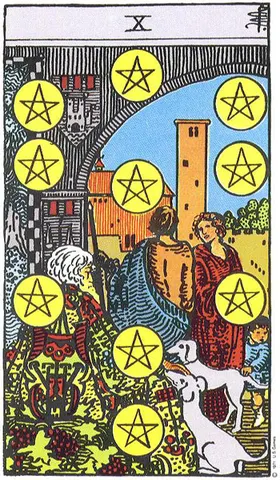
In the Rider–Waite–Smith image, an older figure, younger people, a child and dogs share an architectural setting. The scene connects material security with generations, home and belonging. It explains why the card is often read beyond personal achievement: who benefits from what has been built, and what is being carried forward? These symbolic associations are a reading tradition, not evidence about a particular family.
Ten or Ace of Pentacles?
The Ten focuses on the structure that supports people over time. The Ace of Pentacles focuses on the initial opening. When comparing work choices, use the Ace to explore what can begin and the Ten to examine what could sustain it.
Ten of Pentacles in a future position
In a future position, the Ten of Pentacles can frame a possible direction toward lasting support, shared responsibilities or a more established structure. Reversed, it can raise questions about whether current expectations will support that future. Read the position as a prompt to examine the conditions you are building, not as a date or a guaranteed result.
For a relationship
What have you both agreed about the life you want to share?
For work
What would make this role sustainable over time, and which conditions remain unknown?
For an outcome position
Revisit the original question. A stable arrangement may be one possible theme, but the card cannot verify a future contract, inheritance or another person's decision.
Interpretation and sources
This guide uses symbolic interpretations in the Rider–Waite–Smith tradition. Practical questions and labelled examples are Moonletter editorial prompts. Interpretations vary and are not verified predictions.
Take the question one step further
Bring your own context
Use this as a learning prompt about the card. It is not a real draw or a prediction.
Ask the assistantA few clear answers
Questions people ask
What does the Ten of Pentacles mean upright?
It often points to long-term foundations, shared resources, community, or legacy. The exact focus depends on the question.
What does the reversed Ten of Pentacles mean?
It may invite review of family or workplace expectations, stability, or unequal roles; it does not predict a specific loss.
What does the Ten of Pentacles mean for career?
It can focus attention on stability, team culture, mentorship, and how work fits into longer-term plans.
Does the Ten of Pentacles mean wealth is coming?
No. It is not a reliable forecast of income, inheritance, or investment performance.
Does the meaning change by spread position?
Yes. Past, present, obstacle, and advice positions frame the card differently.
What does the Ten of Pentacles mean in love?
It commonly represents shared values, commitment and the practical foundations of a life together. Reversed, it can highlight differing expectations or family pressure. It is not a guarantee of marriage or a prediction of separation.
Is the Ten of Pentacles a yes or no?
As a symbolic shorthand, upright can lean toward “yes” for questions about lasting support or shared foundations. Reversed invites closer examination of the arrangement. A real decision still depends on the people, terms and circumstances involved.