Minor Arcana guide
Page of Swords Meaning
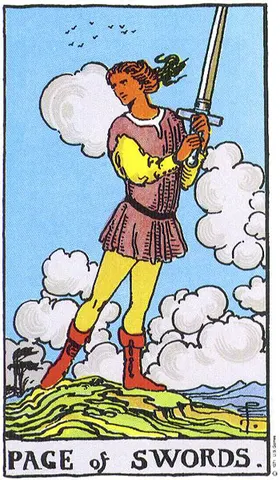
A nimble figure holds a sword while walking across uneven ground under restless clouds. The Page is alert curiosity: observing, asking, checking, and learning how to handle information. Vigilance is useful, but constant scanning can turn every unknown into a threat.
Read the guideBy Moonletter · Updated
A way to read it
Upright: Curiosity and vigilance
Upright, gather facts before forming a strong conclusion. A new topic, interview, or conversation may reward preparation and thoughtful questions. Keep curiosity respectful: observing someone does not entitle you to invade their privacy or spread unverified claims.
A way to read it
Reversed meaning
Reversed, information may be incomplete, poorly delivered, or treated as proof too quickly. Gossip and reactive messages can travel faster than corrections. Slow down, verify the source, and distinguish being watchful from being suspicious of everyone.
Love and relationships
Use these themes alongside actual communication; a card cannot establish another person’s private feelings.
If single
In dating, the Page suits early curiosity and a light, sincere question. Learn whether interests and expectations align without turning conversation into an interrogation. A message can open a door; the other person’s response determines whether it continues.
In a relationship
Partners may benefit from asking a question they have been assuming the answer to. Compare observations without treating every inconsistency as deception. Agree on what needs clarification, and listen for new information rather than preparing the next rebuttal.
As feelings
The Page cannot reveal whether someone watches, researches, or secretly admires you. It may reflect your own curiosity or a need for clearer communication. If you want to know someone, engage directly and respect how much they choose to share.
Reversed in love
Reversed in love, texts may be misread, private details over-shared, or questions delivered as accusations. Check tone and context before reacting. If something matters, ask plainly and give the other person time to answer without monitoring every signal.
Career and work
At work, the Page favors research, careful note-taking, and learning a new process. Verify a report against its source and record assumptions. A junior analyst can add value by asking the question that exposes a gap, provided the finding is shared with care.
Reversed in career
Reversed, a team may circulate screenshots or rumors without context. Establish a source trail and correct errors openly. A monitoring task should have a purpose and limit; endless surveillance produces noise rather than insight.
Future position
In a future position, the Page suggests preparing to learn, ask, or verify something new. It predicts no secret message or conflict. Keep a notebook of questions and check claims before acting on them.
Reading the position
Treat this as a possible developing theme and look for real evidence that supports the interpretation, rather than a guaranteed event.
Yes or no
Editorially, this leans yes to asking and learning, no to spying or repeating rumors. The card cannot guarantee that an inquiry will produce the answer you want. Make the question proportionate and respect the limits of what can be known.
An editorial convention
Yes/no labels are not a universal tarot standard. This guide uses them as reflection prompts, not as factual answers or a substitute for important decisions.
Try a reflection exercise
Choose one claim you have heard recently. Write who said it, what direct evidence supports it, and what remains unknown. Draft a respectful follow-up question that could verify one detail. This is a modern media-literacy reflection.
About this exercise
This is a Moonletter editorial exercise, not an instruction from the historical source.
Imagery and symbolism
Waite describes an active figure walking over rugged ground, holding a sword and looking around amid unsettled clouds. He associates the Page with vigilance, examination, and oversight, with a reversed note about the unforeseen. The modern reading balances alertness with care against suspicion.
Page of Swords vs Ace of Swords
Ace of Swords is a clear claim; Page of Swords is the alert learner who gathers and checks the information behind a claim.
Sources and interpretation
Historical imagery is referenced against A. E. Waite’s The Pictorial Key to the Tarot, Part III (public text on Wikisource). Modern relationship and work applications and exercises are editorial interpretations. Tarot symbolism is not scientific evidence about future events or another person’s thoughts.
Take the question one step further
Bring your own context
Use this as a learning prompt about the card. It is not a real draw or a prediction.
Ask the assistantA few clear answers
Questions people ask
What does the Page of Swords mean?
A nimble figure holds a sword while walking across uneven ground under restless clouds. The Page is alert curiosity: observing, asking, checking, and learning how to handle information. Vigilance is useful, but constant scanning can turn every unknown into a threat.
What does the Page of Swords reversed mean?
Reversed, information may be incomplete, poorly delivered, or treated as proof too quickly. Gossip and reactive messages can travel faster than corrections. Slow down, verify the source, and distinguish being watchful from being suspicious of everyone.
What does the Page of Swords mean in love?
Partners may benefit from asking a question they have been assuming the answer to. Compare observations without treating every inconsistency as deception. Agree on what needs clarification, and listen for new information rather than preparing the next rebuttal.
Is the Page of Swords a yes or no?
Editorially, this leans yes to asking and learning, no to spying or repeating rumors. The card cannot guarantee that an inquiry will produce the answer you want. Make the question proportionate and respect the limits of what can be known.