Minor Arcana guide
Nine of Swords Meaning
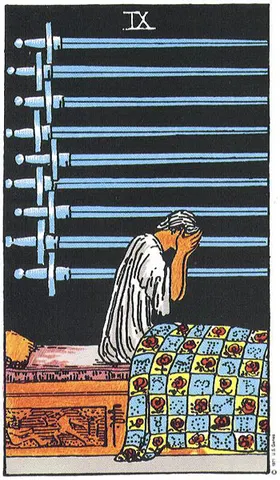
A seated figure wakes beneath nine hanging swords. The Nine gives form to worry, regret, or a night when thoughts grow louder than evidence. It is not a prediction of death, illness, or inevitable failure; the image asks what is known, what is feared, and what support is available.
Read the guideBy Moonletter · Updated
A way to read it
Upright: Worry and rumination
Upright, acknowledge the concern without treating the worst imagined outcome as fact. Write down the specific issue and one checkable next step for daylight hours. A difficult night can distort scale; postpone irreversible decisions until you have clearer information when possible.
A way to read it
Reversed meaning
Reversed, worry may be easing, hidden shame may be spoken, or distress may remain unshared. No single direction is guaranteed. Consider whether naming the concern to a trusted person would help, and distinguish a solvable task from uncertainty that cannot be controlled today.
Love and relationships
Use these themes alongside actual communication; a card cannot establish another person’s private feelings.
If single
For dating, this may mirror anxious overthinking after a message or uncertain interaction. One delay does not establish rejection or betrayal. Decide what evidence would answer your question, then send one calm message if appropriate rather than rereading the exchange all night.
In a relationship
Partners may be carrying guilt or fear that has not been voiced. Make room for a conversation that asks what is worrying each person, without promising that one talk will fix everything. Agree on a practical next step and revisit it when both are rested.
As feelings
The card cannot diagnose another person’s feelings or reveal a secret. It may reflect your own fear, someone’s remorse, or stress around the connection. Check in respectfully and let the answer remain theirs; do not demand disclosure because a reading suggests worry.
Reversed in love
Reversed in love, a private worry may be ready for discussion, or reassurance may be repeatedly sought without resolving the issue. Ask for one specific reassurance or change, and notice whether action follows. Respect privacy while deciding what uncertainty you can live with.
Career and work
At work, the Nine can accompany a looming review, missed deadline, or fear of having made an error. Separate what happened from what you predict will happen. Gather the relevant record, tell the right person early, and propose a correction where possible.
Reversed in career
Reversed, stress may be losing its grip, but fatigue can still impair judgment. Reduce avoidable load, clarify priorities, and request a review of assumptions. A team should address workload conditions rather than treating every sign of strain as an individual failure.
Future position
In a future position, use the Nine as a prompt to plan support for a stressful possibility, not as a forecast that distress will occur. Identify what you can verify, who you can contact, and what decision can wait until you have rested.
Reading the position
Treat this as a possible developing theme and look for real evidence that supports the interpretation, rather than a guaranteed event.
Yes or no
Editorially, this leans no to acting solely from panic and yes to checking a specific concern with care. It cannot answer medical, legal, or safety questions. Use qualified help for those matters and do not treat tarot as diagnosis or professional advice.
An editorial convention
Yes/no labels are not a universal tarot standard. This guide uses them as reflection prompts, not as factual answers or a substitute for important decisions.
Try a reflection exercise
Write the feared outcome in one sentence. Mark each part as observed fact, interpretation, or unknown. Then choose one proportionate action for the unknown and one kind thing you can do for yourself tonight. This exercise is reflective, not clinical care.
About this exercise
This is a Moonletter editorial exercise, not an instruction from the historical source.
Imagery and symbolism
Waite depicts a figure lamenting on a couch beneath swords and lists severe divinatory terms including despair and disappointment. This guide treats the image as a representation of distress, not a literal forecast; a card cannot establish illness, death, pregnancy loss, or any diagnosis.
Nine of Swords vs Eight of Swords
Eight of Swords focuses on felt constraints around a person; Nine of Swords turns inward to worry and the stories thought may build at night.
Sources and interpretation
Historical imagery is referenced against A. E. Waite’s The Pictorial Key to the Tarot, Part III (public text on Wikisource). Modern relationship and work applications and exercises are editorial interpretations. Tarot symbolism is not scientific evidence about future events or another person’s thoughts.
Take the question one step further
Bring your own context
Use this as a learning prompt about the card. It is not a real draw or a prediction.
Ask the assistantA few clear answers
Questions people ask
What does the Nine of Swords mean?
A seated figure wakes beneath nine hanging swords. The Nine gives form to worry, regret, or a night when thoughts grow louder than evidence. It is not a prediction of death, illness, or inevitable failure; the image asks what is known, what is feared, and what support is available.
What does the Nine of Swords reversed mean?
Reversed, worry may be easing, hidden shame may be spoken, or distress may remain unshared. No single direction is guaranteed. Consider whether naming the concern to a trusted person would help, and distinguish a solvable task from uncertainty that cannot be controlled today.
What does the Nine of Swords mean in love?
Partners may be carrying guilt or fear that has not been voiced. Make room for a conversation that asks what is worrying each person, without promising that one talk will fix everything. Agree on a practical next step and revisit it when both are rested.
Is the Nine of Swords a yes or no?
Editorially, this leans no to acting solely from panic and yes to checking a specific concern with care. It cannot answer medical, legal, or safety questions. Use qualified help for those matters and do not treat tarot as diagnosis or professional advice.