Minor Arcana guide
Six of Swords Meaning
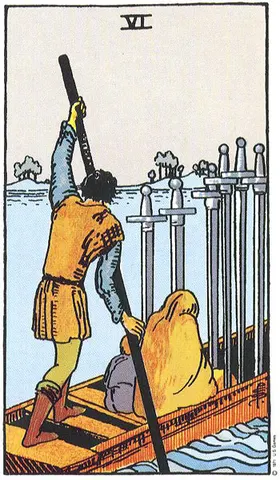
A ferryman carries passengers across quiet water toward another shore. The Six is transition with help: leaving a difficult stretch does not erase it, but creates distance and a route forward. Progress may be gradual, practical, and shared rather than triumphant.
Read the guideBy Moonletter · Updated
A way to read it
Upright: Transition and support
Upright, consider what you are carrying, what can be left behind, and who can help with the crossing. A move, role change, or calmer routine may improve conditions without solving everything at once. Focus on the next reachable shore.
A way to read it
Reversed meaning
Reversed, transition may be delayed by unresolved logistics, reluctance, or a return to familiar conditions. Check whether the obstacle is emotional, financial, or practical. Adjust the route instead of blaming yourself for not moving at the pace you imagined.
Love and relationships
Use these themes alongside actual communication; a card cannot establish another person’s private feelings.
If single
In dating, the Six may point to moving beyond an old pattern or being open to meeting someone in a different setting. It does not guarantee a new partner. Let a new connection develop at a pace that feels safe, without asking it to erase the past.
In a relationship
For partners, this card can describe navigating a transition together: a move, recovery after conflict, or changing responsibilities. Agree on what support looks like during the crossing. One person should not be expected to carry every practical and emotional burden.
As feelings
As feelings, the card may suggest someone wants calmer ground or is processing a change. It cannot tell whether they are leaving you or moving closer. Ask about intentions and observe choices; the boat is a symbol, not a private message from another person.
Reversed in love
Reversed in love, the past may be hard to leave or the next step may feel unclear. Avoid pressuring a partner to “move on” on your schedule. Identify one small transition both consent to, and revisit whether it is helping.
Career and work
At work, this can represent transferring responsibilities, changing teams, or moving a project out of a troubled phase. Make handoffs explicit: status, risks, owner, and next checkpoint. A calm transition depends on information moving with the people.
Reversed in career
Reversed, a project may appear to move while key dependencies remain behind. List blockers and who can remove them. If a transition is no longer viable, revise the destination instead of repeating a plan that conditions have invalidated.
Future position
In a future position, treat the Six as an invitation to prepare for a transition and seek appropriate help. It does not promise escape or a particular destination. Identify the first practical step, the support required, and a way to check that the new route is better.
Reading the position
Treat this as a possible developing theme and look for real evidence that supports the interpretation, rather than a guaranteed event.
Yes or no
Editorially, this leans yes for a considered move toward calmer conditions, provided the route is feasible. It leans no to expecting change without participation or planning. A card cannot assess your actual constraints; compare options and seek relevant advice.
An editorial convention
Yes/no labels are not a universal tarot standard. This guide uses them as reflection prompts, not as factual answers or a substitute for important decisions.
Try a reflection exercise
Draw a simple three-stop route: current shore, crossing, next shore. Put one task, helper, and uncertainty at each stop. Circle only the next action you can take this week. This turns a large transition into a sequence you can review.
About this exercise
This is a Moonletter editorial exercise, not an instruction from the historical source.
Imagery and symbolism
Waite describes a ferryman transporting passengers in a punt over a smooth course, noting that the load is manageable. His meanings include journey, route, envoy, and expedient. The modern reading emphasizes that passage is possible through an ordinary means and may still require assistance.
Six of Swords vs Five of Swords
Five of Swords asks whether conflict is worth continuing; Six of Swords asks what route could carry you beyond it.
Sources and interpretation
Historical imagery is referenced against A. E. Waite’s The Pictorial Key to the Tarot, Part III (public text on Wikisource). Modern relationship and work applications and exercises are editorial interpretations. Tarot symbolism is not scientific evidence about future events or another person’s thoughts.
Take the question one step further
Bring your own context
Use this as a learning prompt about the card. It is not a real draw or a prediction.
Ask the assistantA few clear answers
Questions people ask
What does the Six of Swords mean?
A ferryman carries passengers across quiet water toward another shore. The Six is transition with help: leaving a difficult stretch does not erase it, but creates distance and a route forward. Progress may be gradual, practical, and shared rather than triumphant.
What does the Six of Swords reversed mean?
Reversed, transition may be delayed by unresolved logistics, reluctance, or a return to familiar conditions. Check whether the obstacle is emotional, financial, or practical. Adjust the route instead of blaming yourself for not moving at the pace you imagined.
What does the Six of Swords mean in love?
For partners, this card can describe navigating a transition together: a move, recovery after conflict, or changing responsibilities. Agree on what support looks like during the crossing. One person should not be expected to carry every practical and emotional burden.
Is the Six of Swords a yes or no?
Editorially, this leans yes for a considered move toward calmer conditions, provided the route is feasible. It leans no to expecting change without participation or planning. A card cannot assess your actual constraints; compare options and seek relevant advice.