Minor Arcana guide
Five of Swords Meaning
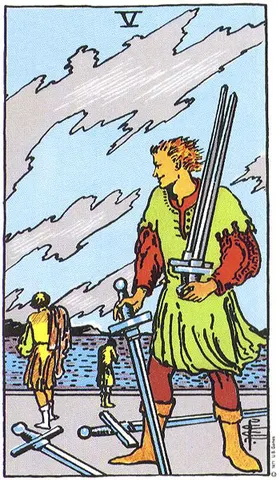
One figure gathers swords while two others withdraw. The Five asks what a win costs when the contest leaves trust, dignity, or cooperation damaged. It can describe conflict without declaring one person wholly right. Notice who benefits, who bears the cost, and whether continuing serves any purpose.
Read the guideBy Moonletter · Updated
A way to read it
Upright: Conflict and its cost
Upright, tension may be fueled by scorekeeping, sharp remarks, or a desire to prove superiority. Choose whether the issue matters enough to address. A clean apology or a negotiated boundary may accomplish more than another rebuttal.
A way to read it
Reversed meaning
Reversed, conflict may be settling, or resentment may remain after an apparent resolution. Do not assume silence means repair. Ask what each person needs to move forward and whether the agreement is being followed.
Love and relationships
Use these themes alongside actual communication; a card cannot establish another person’s private feelings.
If single
In dating, this card cautions against turning attraction into a contest for leverage. If a disagreement arises, discuss the behavior rather than humiliating the person. A mismatch in values may be clearer than a dramatic victory.
In a relationship
Partners should identify the recurring dispute beneath the latest argument. Agree on one change each person can make and a way to revisit it. If one partner feels unsafe or coerced, prioritize safety and outside support rather than treating reconciliation as the goal.
As feelings
This card cannot tell whether someone is secretly angry or regretful. It may reflect your concern about conflict or the impression of emotional distance. Check directly, and judge by accountable behavior rather than a guessed inner state.
Reversed in love
Reversed in love, old arguments can resurface as sarcasm, scorekeeping, or a demand to concede. Pause the exchange and return to the actual need. Repair requires voluntary participation; do not confuse surrender with mutual understanding.
Career and work
At work, the Five can describe a competitive meeting where winning the room matters more than solving the problem. Clarify the shared objective, document dissent, and keep credit and responsibility accurate. A firm disagreement can stay professional when people critique proposals rather than character.
Reversed in career
Reversed, a team may be ready to de-escalate but unsure how to acknowledge damage. Name the concrete impact and set a process for future disputes. Avoid public blame if a private correction can restore accountability more fairly.
Future position
In a future position, the Five asks you to consider how you want to handle a possible disagreement. It predicts no betrayal or inevitable defeat. Prepare a boundary, a listening question, and a point at which walking away is wiser than escalating.
Reading the position
Treat this as a possible developing theme and look for real evidence that supports the interpretation, rather than a guaranteed event.
Yes or no
Editorially, this leans no for revenge or domination and yes to addressing a real issue with clear limits. If the question is who will win, the card offers no reliable forecast. Reframe toward the outcome you can influence.
An editorial convention
Yes/no labels are not a universal tarot standard. This guide uses them as reflection prompts, not as factual answers or a substitute for important decisions.
Try a reflection exercise
Recall a recent disagreement. Write the goal you wanted, the impact of your approach, and one sentence that could keep the issue firm without attacking the person. Choose whether repair, a boundary, or disengagement is appropriate.
About this exercise
This is a Moonletter editorial exercise, not an instruction from the historical source.
Imagery and symbolism
Waite depicts a disdainful figure holding swords while two others withdraw, associating the card with loss, dishonor, and destruction. The picture leaves the victor alone with the field. Modern application asks whether possession of the argument is worth the relational cost.
Five of Swords vs Four of Swords
Four of Swords steps back to recover; Five of Swords returns to a contested field and asks whether engagement is worth its cost.
Sources and interpretation
Historical imagery is referenced against A. E. Waite’s The Pictorial Key to the Tarot, Part III (public text on Wikisource). Modern relationship and work applications and exercises are editorial interpretations. Tarot symbolism is not scientific evidence about future events or another person’s thoughts.
Take the question one step further
Bring your own context
Use this as a learning prompt about the card. It is not a real draw or a prediction.
Ask the assistantA few clear answers
Questions people ask
What does the Five of Swords mean?
One figure gathers swords while two others withdraw. The Five asks what a win costs when the contest leaves trust, dignity, or cooperation damaged. It can describe conflict without declaring one person wholly right. Notice who benefits, who bears the cost, and whether continuing serves any purpose.
What does the Five of Swords reversed mean?
Reversed, conflict may be settling, or resentment may remain after an apparent resolution. Do not assume silence means repair. Ask what each person needs to move forward and whether the agreement is being followed.
What does the Five of Swords mean in love?
Partners should identify the recurring dispute beneath the latest argument. Agree on one change each person can make and a way to revisit it. If one partner feels unsafe or coerced, prioritize safety and outside support rather than treating reconciliation as the goal.
Is the Five of Swords a yes or no?
Editorially, this leans no for revenge or domination and yes to addressing a real issue with clear limits. If the question is who will win, the card offers no reliable forecast. Reframe toward the outcome you can influence.