Minor Arcana guide
Seven of Swords Meaning
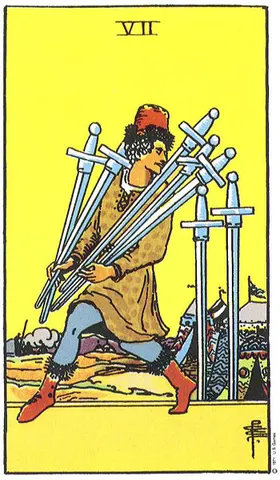
A figure carries five swords from a camp while two remain behind. The Seven concerns strategy, selective disclosure, and the difference between privacy and deception. It can describe resourcefulness, but also a plan whose hidden costs may catch up with its author.
Read the guideBy Moonletter · Updated
A way to read it
Upright: Strategy and discretion
Upright, work intelligently with limited resources and decide what truly needs to be shared. Check that discretion is not becoming evasion. A clever workaround is useful only if it respects agreements and does not shift hidden risk onto someone else.
A way to read it
Reversed meaning
Reversed, concealed information may surface, or you may recognize that a solo strategy is failing. Seek advice, correct a misleading account, and make a realistic plan. If you are the one being misled, verify before accusing.
Love and relationships
Use these themes alongside actual communication; a card cannot establish another person’s private feelings.
If single
In dating, the Seven advises pacing disclosure while staying honest about intentions. Privacy is reasonable; presenting a false identity or keeping someone as a backup is not. Ask what you need to know and share enough for the other person to make an informed choice.
In a relationship
Partners may need to discuss secrecy, personal space, or unequal access to information. Avoid surveillance as a substitute for trust. Agree on what is private, what affects shared decisions, and how either person can raise concerns without punishment.
As feelings
This card cannot prove that a person is lying. It can reflect guardedness, strategic thinking, or your worry about omissions. Ask a specific question and assess verifiable behavior; avoid converting suspicion into certainty without evidence.
Reversed in love
Reversed in love, a hidden expectation or half-truth may be undermining trust. State what needs clarification and give the other person a chance to answer. If deception is confirmed, decide what boundary protects you rather than bargaining away your own judgment.
Career and work
At work, the Seven can favor a discreet pilot, a negotiated workaround, or protecting confidential information. Keep approvals and records in order. A shortcut that bypasses accountability may save a day and create a much larger problem later.
Reversed in career
Reversed, a plan may be exposed as incomplete or a team may discover that one person has withheld a dependency. Focus on correction, impact, and prevention. Do not turn an operational mistake into an accusation about character without evidence.
Future position
In a future position, the Seven asks you to consider what should remain private and what must be transparent in an upcoming decision. It predicts no betrayal. Set ethical limits on strategy and document the facts on which your plan depends.
Reading the position
Treat this as a possible developing theme and look for real evidence that supports the interpretation, rather than a guaranteed event.
Yes or no
Editorially, this leans yes for careful planning and protecting legitimate privacy; no for deceit or avoiding a necessary conversation. The card cannot certify that a scheme will work. Check the consequences for everyone affected.
An editorial convention
Yes/no labels are not a universal tarot standard. This guide uses them as reflection prompts, not as factual answers or a substitute for important decisions.
Try a reflection exercise
Write the plan you are considering, then mark each step “private,” “shared,” or “needs consent.” For every private step, ask whether it protects a boundary or hides a consequence from someone who bears it. Revise one step accordingly.
About this exercise
This is a Moonletter editorial exercise, not an instruction from the historical source.
Imagery and symbolism
Waite depicts a man carrying away five swords while two remain near a camp. He notes contradictory readings: attempt, hope, confidence, quarrelling, and a plan that may fail. That ambiguity supports a modern distinction between prudent strategy and self-defeating concealment.
Seven of Swords vs Six of Swords
Six of Swords makes a visible crossing with passengers; Seven of Swords moves alone through a camp, emphasizing private strategy and its accountability.
Sources and interpretation
Historical imagery is referenced against A. E. Waite’s The Pictorial Key to the Tarot, Part III (public text on Wikisource). Modern relationship and work applications and exercises are editorial interpretations. Tarot symbolism is not scientific evidence about future events or another person’s thoughts.
Take the question one step further
Bring your own context
Use this as a learning prompt about the card. It is not a real draw or a prediction.
Ask the assistantA few clear answers
Questions people ask
What does the Seven of Swords mean?
A figure carries five swords from a camp while two remain behind. The Seven concerns strategy, selective disclosure, and the difference between privacy and deception. It can describe resourcefulness, but also a plan whose hidden costs may catch up with its author.
What does the Seven of Swords reversed mean?
Reversed, concealed information may surface, or you may recognize that a solo strategy is failing. Seek advice, correct a misleading account, and make a realistic plan. If you are the one being misled, verify before accusing.
What does the Seven of Swords mean in love?
Partners may need to discuss secrecy, personal space, or unequal access to information. Avoid surveillance as a substitute for trust. Agree on what is private, what affects shared decisions, and how either person can raise concerns without punishment.
Is the Seven of Swords a yes or no?
Editorially, this leans yes for careful planning and protecting legitimate privacy; no for deceit or avoiding a necessary conversation. The card cannot certify that a scheme will work. Check the consequences for everyone affected.