Minor Arcana guide
Seven of Wands Meaning
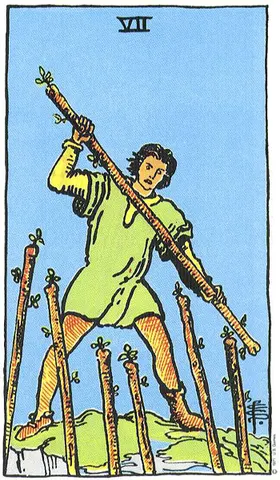
The Seven of Wands shows a figure holding the higher ground while other staffs rise from below. It captures the pressure of defending a position. The card asks what is worth protecting, what evidence supports your stance, and whether the effort required to hold it remains proportionate.
Read the guideBy Moonletter · Updated
A way to read it
Upright: Conviction and boundaries
Upright, it suggests courage, persistence, and the need to answer challenges without abandoning a considered position. In work this may be competition or negotiation; in daily life it may be maintaining a boundary. Confidence helps when it is paired with preparation and a willingness to hear a valid objection.
A way to read it
Reversed meaning
Reversed, the card can describe feeling outnumbered, overwhelmed, or unsure which challenge deserves attention. Indecision may make each demand feel urgent. It can also warn against defending every point simply because someone questioned it. Sort the issues by importance and seek help where the load is too large.
Love and relationships
Use these themes alongside actual communication; a card cannot establish another person’s private feelings.
If single
For a single person, this may reflect protecting personal standards while dating or feeling that attention comes with pressure to compete. You do not need to audition for a connection. Explain your boundaries clearly and notice whether someone responds with respect rather than treating them as obstacles to overcome.
In a relationship
For partners, the card can point to defending one’s needs during a difficult conversation. Each person deserves space to explain a position, but the goal is understanding rather than winning. Agree on the specific issue under discussion so that old grievances do not arrive as a crowd of new demands.
As feelings
Feelings may be guarded, determined, or protective of a fragile gain. Someone might care but feel challenged by circumstances or by the need to stand up for their perspective. The card does not confirm that others are enemies; it asks what is truly at stake and what support would help.
Reversed in love
Reversed in love, exhaustion or self-doubt can make it hard to state a need, while defensiveness can turn a small disagreement into a test of loyalty. Take a pause before responding. Name the boundary and its reason, then ask whether a workable compromise exists without giving up your safety or dignity.
Career and work
At work, this is the moment to defend a proposal with evidence: explain why a design, budget, or schedule deserves support. Anticipate reasonable objections and distinguish them from personal attacks. A strong position becomes more credible when it can absorb questions and still improve.
Reversed in career
Reversed, too many competing demands may leave you scattered, or you may defend a weak plan out of pride. Prioritize the risks that matter, consult someone with relevant expertise, and revise where the evidence calls for it. Persistence is valuable only when the purpose remains sound.
Future position
In a future position, the Seven asks which boundary or decision may need defending. Clarify your reasons now, and decide how much time a challenge deserves. You can respond firmly without treating every disagreement as an attack; the image offers a stance to consider, not a prediction of confrontation.
Reading the position
Treat this as a possible developing theme and look for real evidence that supports the interpretation, rather than a guaranteed event.
Yes or no
Editorially, this is a conditional yes for defending a principled position when facts and boundaries support it. It is no to fighting every challenger or protecting an idea solely to avoid admitting a mistake. The card’s high ground is useful only if the stance is defensible.
An editorial convention
Yes/no labels are not a universal tarot standard. This guide uses them as reflection prompts, not as factual answers or a substitute for important decisions.
Try a reflection exercise
List the three demands currently competing for your attention. Circle the one that matters most, write the evidence behind your position, and identify one person who could support you. Decide which request you can decline or postpone. This exercise replaces generalized pressure with a chosen boundary.
About this exercise
This is a Moonletter editorial exercise, not an instruction from the historical source.
Imagery and symbolism
The raised ground gives the figure a temporary advantage, while six staffs point upward from outside the frame. The image conveys effort under pressure and a limited field of view. Historical readings emphasize valor and negotiation, but the picture also invites a check on whether defense is sustainable.
Seven of Wands vs Six of Wands
The Six celebrates visible approval; the Seven shifts from receiving recognition to defending a position under pressure.
Sources and interpretation
Historical imagery is referenced against A. E. Waite’s The Pictorial Key to the Tarot, Part III (public text on Wikisource). Modern relationship and work applications and exercises are editorial interpretations. Tarot symbolism is not scientific evidence about future events or another person’s thoughts.
Take the question one step further
Bring your own context
Use this as a learning prompt about the card. It is not a real draw or a prediction.
Ask the assistantA few clear answers
Questions people ask
What does the Seven of Wands mean?
The Seven of Wands shows a figure holding the higher ground while other staffs rise from below. It captures the pressure of defending a position. The card asks what is worth protecting, what evidence supports your stance, and whether the effort required to hold it remains proportionate.
What does the Seven of Wands reversed mean?
Reversed, the card can describe feeling outnumbered, overwhelmed, or unsure which challenge deserves attention. Indecision may make each demand feel urgent. It can also warn against defending every point simply because someone questioned it. Sort the issues by importance and seek help where the load is too large.
What does the Seven of Wands mean in love?
For partners, the card can point to defending one’s needs during a difficult conversation. Each person deserves space to explain a position, but the goal is understanding rather than winning. Agree on the specific issue under discussion so that old grievances do not arrive as a crowd of new demands.
Is the Seven of Wands a yes or no?
Editorially, this is a conditional yes for defending a principled position when facts and boundaries support it. It is no to fighting every challenger or protecting an idea solely to avoid admitting a mistake. The card’s high ground is useful only if the stance is defensible.