Minor Arcana guide
Eight of Swords Meaning
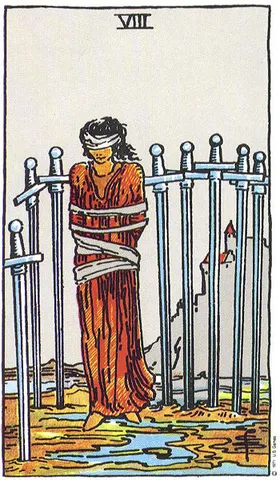
A bound, blindfolded figure stands among swords, yet the scene leaves some ground open. The Eight portrays constraints that feel enclosing and the small choices still visible within them. It does not mean every obstacle is imaginary; distinguish external limits from assumptions that may be tested.
Read the guideBy Moonletter · Updated
A way to read it
Upright: Restriction and perspective
Upright, name the actual constraint: policy, money, timing, fear of conflict, or missing support. Then identify one low-risk action still available. Progress may begin with asking for help or obtaining information, not with dramatic escape.
A way to read it
Reversed meaning
Reversed, a constraint may be loosening, or frustration may make you rush without checking the route. Test one assumption and watch for consequences. If a barrier is real and unsafe to challenge alone, plan with trusted support instead of blaming yourself for its existence.
Love and relationships
Use these themes alongside actual communication; a card cannot establish another person’s private feelings.
If single
In dating, this card may reflect feeling unable to initiate, disclose, or leave an unsatisfying situation. Identify what is genuinely preventing choice and what support could widen it. You deserve agency, but no card can judge the safety of a particular relationship.
In a relationship
Partners can discuss a pattern in which one person feels unheard or boxed in. Ask what specific behavior would create more room. If control, intimidation, or fear is present, prioritize safety and seek appropriate trusted help rather than relying on a private negotiation alone.
As feelings
The card cannot reveal whether someone feels trapped by you or by circumstances. It may reflect your own sense of limited options. Ask openly and respect the answer; do not use symbolism to excuse controlling another person’s choices.
Reversed in love
Reversed in love, a stuck pattern may become discussable, but relief is not automatic. Replace “you never let me” with a concrete request and check whether it is accepted. If it is refused, use that information to decide your own boundary.
Career and work
At work, the Eight can represent limited authority, unclear approval paths, or fear of raising a risk. Map who controls each decision and what evidence is needed. A written question to the right owner may open more room than another private worry cycle.
Reversed in career
Reversed, constraints may ease when ownership changes, but a team can also mistake a temporary workaround for a permanent solution. Document what changed, what remains blocked, and who will verify the result.
Future position
In a future position, the Eight invites preparation for a situation that may feel restrictive by listing choices and support in advance. It predicts no crisis or captivity. Identify a safe contact and one step you can take if your first option is unavailable.
Reading the position
Treat this as a possible developing theme and look for real evidence that supports the interpretation, rather than a guaranteed event.
Yes or no
Editorially, this is a conditional answer: yes to examining options and seeking support, no to assuming helplessness is permanent. It cannot tell whether a risk is safe to take. Base action on the real situation and available help.
An editorial convention
Yes/no labels are not a universal tarot standard. This guide uses them as reflection prompts, not as factual answers or a substitute for important decisions.
Try a reflection exercise
Draw the boundary you feel around the problem. Label each edge with its source: a rule, a person, a resource, or an assumption. Circle one edge you can investigate safely and write the person or document that could clarify it.
About this exercise
This is a Moonletter editorial exercise, not an instruction from the historical source.
Imagery and symbolism
Waite describes a bound and blindfolded woman surrounded by swords, interpreting the scene as temporary rather than irretrievable confinement. His meanings include crisis and power constrained. This modern guide preserves both sides: constraints can be real, yet routes and support may exist.
Eight of Swords vs Seven of Swords
Seven of Swords asks what is being kept back; Eight of Swords asks which limits are real and where a safe choice remains.
Sources and interpretation
Historical imagery is referenced against A. E. Waite’s The Pictorial Key to the Tarot, Part III (public text on Wikisource). Modern relationship and work applications and exercises are editorial interpretations. Tarot symbolism is not scientific evidence about future events or another person’s thoughts.
Take the question one step further
Bring your own context
Use this as a learning prompt about the card. It is not a real draw or a prediction.
Ask the assistantA few clear answers
Questions people ask
What does the Eight of Swords mean?
A bound, blindfolded figure stands among swords, yet the scene leaves some ground open. The Eight portrays constraints that feel enclosing and the small choices still visible within them. It does not mean every obstacle is imaginary; distinguish external limits from assumptions that may be tested.
What does the Eight of Swords reversed mean?
Reversed, a constraint may be loosening, or frustration may make you rush without checking the route. Test one assumption and watch for consequences. If a barrier is real and unsafe to challenge alone, plan with trusted support instead of blaming yourself for its existence.
What does the Eight of Swords mean in love?
Partners can discuss a pattern in which one person feels unheard or boxed in. Ask what specific behavior would create more room. If control, intimidation, or fear is present, prioritize safety and seek appropriate trusted help rather than relying on a private negotiation alone.
Is the Eight of Swords a yes or no?
Editorially, this is a conditional answer: yes to examining options and seeking support, no to assuming helplessness is permanent. It cannot tell whether a risk is safe to take. Base action on the real situation and available help.