Minor Arcana guide
Knight of Swords Meaning
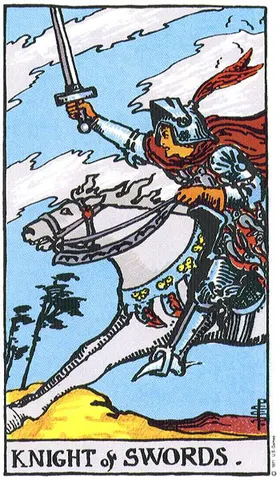
A rider charges forward with sword raised as the wind drives the scene. The Knight represents speed, conviction, and forceful action. These qualities can cut through delay, yet momentum without listening can scatter people and damage the very goal being pursued.
Read the guideBy Moonletter · Updated
A way to read it
Upright: Direct action and haste
Upright, act decisively when the facts and purpose are clear. State the objective, check who will be affected, and give people enough context to respond. Courage is not the same as haste; a short pause can sharpen the action.
A way to read it
Reversed meaning
Reversed, speed may outrun capacity, preparation, or judgment. Overpromising, interrupting, or charging into a dispute can create avoidable damage. Reduce pace, check resources, and invite correction before making a claim difficult to retract.
Love and relationships
Use these themes alongside actual communication; a card cannot establish another person’s private feelings.
If single
In dating, the Knight can mean boldly expressing interest or rushing toward a conclusion. Make an invitation, not a demand. Directness is appealing when it leaves room for consent, timing, and a genuine no.
In a relationship
Partners can channel urgency into one clear conversation about what needs to change. Avoid using intensity to force agreement. Set a time limit for the discussion, summarize both views, and decide what action each person freely accepts.
As feelings
As feelings, it may suggest strong attention, impatience, or a wish to speak, but not prove devotion or hostility. Ask what the person intends and observe follow-through. Energy is not the same as emotional availability.
Reversed in love
Reversed in love, blunt words or impulsive pursuit may overwhelm the connection. Pause before sending repeated messages or issuing ultimatums. Make one respectful statement, then allow space for an answer and accept the boundary given.
Career and work
At work, this card can suit a deadline-driven push, decisive negotiation, or rapid response to a genuine issue. Confirm the facts, assign roles, and define what must not be broken under pressure. Speed is useful when the team knows where it is going.
Reversed in career
Reversed, a rushed launch, hostile email, or unrealistic timeline may be looming. Add a review step and ask a colleague to challenge the plan. If the deadline cannot move, reduce scope instead of pretending quality has no cost.
Future position
In a future position, the Knight asks you to prepare for a moment that may call for decisive communication. It predicts no confrontation or sudden event. Know your evidence, desired outcome, and stopping point before entering a high-pressure exchange.
Reading the position
Treat this as a possible developing theme and look for real evidence that supports the interpretation, rather than a guaranteed event.
Yes or no
Editorially, this leans yes for swift action when evidence and consent are present; no for rushing because urgency feels exciting. It cannot promise success. Check whether the pace matches your capacity and the consequences for others.
An editorial convention
Yes/no labels are not a universal tarot standard. This guide uses them as reflection prompts, not as factual answers or a substitute for important decisions.
Try a reflection exercise
Before an urgent action, write the outcome, evidence, affected people, and one risk of moving too fast. Ask someone to challenge the weakest assumption. Then choose a pace you can sustain for the whole task, not just its dramatic start.
About this exercise
This is a Moonletter editorial exercise, not an instruction from the historical source.
Imagery and symbolism
Waite depicts the Knight riding at full course and associates him with skill, bravery, defense, opposition, and destruction; he cautions that death is not a standalone meaning. This guide emphasizes the visible momentum and the need to direct it with judgment.
Knight of Swords vs Page of Swords
Page of Swords observes and checks; Knight of Swords converts information into fast action, with greater risk if preparation lags.
Sources and interpretation
Historical imagery is referenced against A. E. Waite’s The Pictorial Key to the Tarot, Part III (public text on Wikisource). Modern relationship and work applications and exercises are editorial interpretations. Tarot symbolism is not scientific evidence about future events or another person’s thoughts.
Take the question one step further
Bring your own context
Use this as a learning prompt about the card. It is not a real draw or a prediction.
Ask the assistantA few clear answers
Questions people ask
What does the Knight of Swords mean?
A rider charges forward with sword raised as the wind drives the scene. The Knight represents speed, conviction, and forceful action. These qualities can cut through delay, yet momentum without listening can scatter people and damage the very goal being pursued.
What does the Knight of Swords reversed mean?
Reversed, speed may outrun capacity, preparation, or judgment. Overpromising, interrupting, or charging into a dispute can create avoidable damage. Reduce pace, check resources, and invite correction before making a claim difficult to retract.
What does the Knight of Swords mean in love?
Partners can channel urgency into one clear conversation about what needs to change. Avoid using intensity to force agreement. Set a time limit for the discussion, summarize both views, and decide what action each person freely accepts.
Is the Knight of Swords a yes or no?
Editorially, this leans yes for swift action when evidence and consent are present; no for rushing because urgency feels exciting. It cannot promise success. Check whether the pace matches your capacity and the consequences for others.