Minor Arcana guide
Five of Wands Meaning
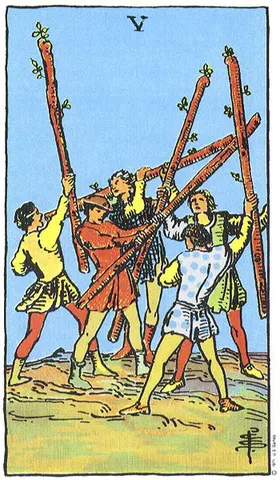
The Five of Wands shows several people raising staffs in a scene that could be play, rehearsal, or conflict. The image is busy and unsettled. Its useful question is whether competing energy is helping everyone improve, or whether the contest has stopped serving any shared purpose.
Read the guideBy Moonletter · Updated
A way to read it
Upright: Competition and friction
Upright, it can describe rivalry, debate, friction, or a demanding environment where people test their skills. Competition is not automatically harmful: clear rules and mutual respect can turn it into practice. But repeated interruptions, unclear roles, and personal attacks turn lively challenge into avoidable conflict.
A way to read it
Reversed meaning
Reversed, the card may suggest a dispute becoming private or indirect, a wish to avoid confrontation, or conflict that has begun to drain people. Hidden resentment does not disappear simply because the argument quiets. Set boundaries, name the issue, and decide whether a fair discussion is possible.
Love and relationships
Use these themes alongside actual communication; a card cannot establish another person’s private feelings.
If single
For a single person, this card may reflect several people vying for attention, playful banter, or the awkwardness of meeting someone in a crowded social field. Do not treat dating as a contest you must win. Notice whether the interaction is fun and respectful or leaves you feeling pushed to prove your worth.
In a relationship
For partners, disagreement can surface around competing needs, schedules, or styles of handling decisions. The card invites a fair exchange rather than scorekeeping. If a conversation becomes a contest of who is right, pause and restate the shared problem each person wants to solve.
As feelings
Feelings may be energized, irritated, or uncertain because signals compete. Someone might enjoy playful tension but also feel challenged or misunderstood. The card cannot tell which person will prevail or reveal a hidden rival; ask what behavior is observable and whether it feels acceptable.
Reversed in love
Reversed in love, conflict can be suppressed to keep peace or expressed through sarcasm and side-taking. Neither pattern resolves the issue. Choose one concern, describe its effect without accusation, and ask for a concrete change. If the exchange becomes unsafe or persistently demeaning, step back and seek appropriate support.
Career and work
At work, expect debate over priorities, limited resources, or how a task should be done. A healthy review can sharpen ideas when the goal and decision owner are clear. Make the criteria visible, give each person a turn, and record the decision so discussion does not recur as personal friction.
Reversed in career
Reversed, a team may avoid a needed disagreement or allow behind-the-scenes competition to shape decisions. Bring the work issue into a structured conversation, clarify who decides, and separate evidence from status. If roles are vague, fix the process before demanding that individuals simply get along.
Future position
In a future position, the Five asks how you would handle disagreement or competition. Set useful rules before a lively discussion becomes a contest for attention. Different views can sharpen a shared plan when there is a clear goal; the card does not establish that a conflict will occur.
Reading the position
Treat this as a possible developing theme and look for real evidence that supports the interpretation, rather than a guaranteed event.
Yes or no
Editorially, this is a conditional answer: yes to entering a fair contest or discussion when the goal is learning and the rules are clear; no to escalating a rivalry that rewards humiliation. The card emphasizes friction, so a smooth outcome should not be assumed.
An editorial convention
Yes/no labels are not a universal tarot standard. This guide uses them as reflection prompts, not as factual answers or a substitute for important decisions.
Try a reflection exercise
Choose one recent disagreement. Write each side’s stated concern in language they would recognize, then identify the shared outcome and one rule for a fair conversation. Decide what evidence would settle the issue. This exercise turns reactive competition into a bounded problem-solving session.
About this exercise
This is a Moonletter editorial exercise, not an instruction from the historical source.
Imagery and symbolism
The crossed staffs create motion without a single obvious victor. Similar clothes and crowded movement make the figures feel like participants in a common field, even while they compete. Historical readings include imitation and struggle; whether the scene is sport or strife remains usefully ambiguous.
Five of Wands vs Four of Wands
The Four gathers people around a shared milestone; the Five puts their differing energies into a contested space.
Sources and interpretation
Historical imagery is referenced against A. E. Waite’s The Pictorial Key to the Tarot, Part III (public text on Wikisource). Modern relationship and work applications and exercises are editorial interpretations. Tarot symbolism is not scientific evidence about future events or another person’s thoughts.
Take the question one step further
Bring your own context
Use this as a learning prompt about the card. It is not a real draw or a prediction.
Ask the assistantA few clear answers
Questions people ask
What does the Five of Wands mean?
The Five of Wands shows several people raising staffs in a scene that could be play, rehearsal, or conflict. The image is busy and unsettled. Its useful question is whether competing energy is helping everyone improve, or whether the contest has stopped serving any shared purpose.
What does the Five of Wands reversed mean?
Reversed, the card may suggest a dispute becoming private or indirect, a wish to avoid confrontation, or conflict that has begun to drain people. Hidden resentment does not disappear simply because the argument quiets. Set boundaries, name the issue, and decide whether a fair discussion is possible.
What does the Five of Wands mean in love?
For partners, disagreement can surface around competing needs, schedules, or styles of handling decisions. The card invites a fair exchange rather than scorekeeping. If a conversation becomes a contest of who is right, pause and restate the shared problem each person wants to solve.
Is the Five of Wands a yes or no?
Editorially, this is a conditional answer: yes to entering a fair contest or discussion when the goal is learning and the rules are clear; no to escalating a rivalry that rewards humiliation. The card emphasizes friction, so a smooth outcome should not be assumed.