Minor Arcana guide
Four of Swords Meaning
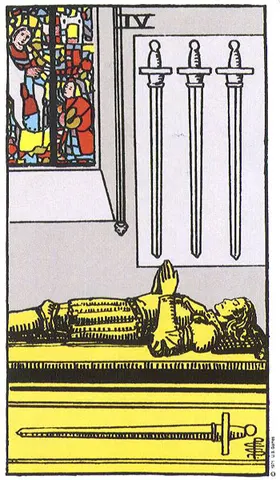
A carved knight rests in prayer above a tomb, with swords arranged nearby. The Four is chosen recovery: withdrawing from noise long enough to regain perspective. Its stillness can be restorative, but indefinite retreat may leave practical matters untouched. Rest is a deliberate interval, not a verdict.
Read the guideBy Moonletter · Updated
A way to read it
Upright: Rest and reflection
Upright, take a pause before answering, launching, or re-entering a conflict. A quiet afternoon, protected focus block, or short break from notifications may be enough. Decide what the pause is for and what signal tells you it is time to return.
A way to read it
Reversed meaning
Reversed, rest may be ending, or exhaustion may be ignored until it shows in rushed choices. Returning too fast can repeat the same cycle. Check whether the underlying demand has changed, and build a sustainable pace rather than treating another burst of effort as recovery.
Love and relationships
Use these themes alongside actual communication; a card cannot establish another person’s private feelings.
If single
For dating, the Four can mean taking time before opening a new conversation or recovering from an intense period. Communicate a pause plainly if someone is waiting on you. Rest should help you choose freely; it need not become a test of whether the other person chases you.
In a relationship
Partners can use the card to agree on a cooling-off interval during conflict. Set a return time and ground rules: no punitive silence, no repeated messages, and a commitment to resume. A pause works when it protects the conversation rather than replacing it.
As feelings
As a feelings card, it may suggest someone is conserving energy or thinking privately, but it cannot confirm why. Quiet can reflect rest, uncertainty, or a wish for distance. Ask what kind of contact is welcome instead of interpreting absence as a hidden message.
Reversed in love
Reversed in love, a pause may be overdue or may have stretched into avoidance. Agree on a manageable next contact rather than demanding instant resolution. If you have asked for space, state when or whether you expect to reconnect; clarity is kinder than leaving someone guessing.
Career and work
At work, the Four favors review, quiet analysis, and protecting time for a high-stakes decision. A product team might freeze new requests for one day to assess a bug report. Use the pause to gather facts and assign a next owner, not merely to postpone accountability.
Reversed in career
Reversed, a team may be backlogged because every decision waits for perfect readiness, or people may return without addressing the source of strain. Set a narrow review window, list the unresolved risks, and choose the smallest safe next action.
Future position
In a future position, the Four invites you to plan for a restorative interval around upcoming demands. It does not predict illness, defeat, or forced isolation. Protect a pause on your calendar and define what will be set aside so rest has a real boundary.
Reading the position
Treat this as a possible developing theme and look for real evidence that supports the interpretation, rather than a guaranteed event.
Yes or no
Editorially, this is a “not yet” for decisions that can safely wait until you are rested, and a yes to taking a bounded break. It is not a reason to ignore urgent responsibilities. Check the actual deadline and consequences before postponing.
An editorial convention
Yes/no labels are not a universal tarot standard. This guide uses them as reflection prompts, not as factual answers or a substitute for important decisions.
Try a reflection exercise
Choose one source of noise to pause for a set period. Write what you hope the quiet will help you notice, and set a return time. At the end, record one insight and one concrete action; this turns retreat into a usable interval.
About this exercise
This is a Moonletter editorial exercise, not an instruction from the historical source.
Imagery and symbolism
Waite describes a knight’s effigy in prayer on a tomb and gives meanings including vigilance, retreat, solitude, and repose. The image holds rest beside mortality without requiring a literal reading. This guide reads the stone figure as a chosen pause and the arranged swords as concerns left waiting.
Four of Swords vs Three of Swords
Three of Swords names the hurt; Four of Swords asks for a restorative pause before deciding how to respond to it.
Sources and interpretation
Historical imagery is referenced against A. E. Waite’s The Pictorial Key to the Tarot, Part III (public text on Wikisource). Modern relationship and work applications and exercises are editorial interpretations. Tarot symbolism is not scientific evidence about future events or another person’s thoughts.
Take the question one step further
Bring your own context
Use this as a learning prompt about the card. It is not a real draw or a prediction.
Ask the assistantA few clear answers
Questions people ask
What does the Four of Swords mean?
A carved knight rests in prayer above a tomb, with swords arranged nearby. The Four is chosen recovery: withdrawing from noise long enough to regain perspective. Its stillness can be restorative, but indefinite retreat may leave practical matters untouched. Rest is a deliberate interval, not a verdict.
What does the Four of Swords reversed mean?
Reversed, rest may be ending, or exhaustion may be ignored until it shows in rushed choices. Returning too fast can repeat the same cycle. Check whether the underlying demand has changed, and build a sustainable pace rather than treating another burst of effort as recovery.
What does the Four of Swords mean in love?
Partners can use the card to agree on a cooling-off interval during conflict. Set a return time and ground rules: no punitive silence, no repeated messages, and a commitment to resume. A pause works when it protects the conversation rather than replacing it.
Is the Four of Swords a yes or no?
Editorially, this is a “not yet” for decisions that can safely wait until you are rested, and a yes to taking a bounded break. It is not a reason to ignore urgent responsibilities. Check the actual deadline and consequences before postponing.