Minor Arcana guide
King of Swords Meaning
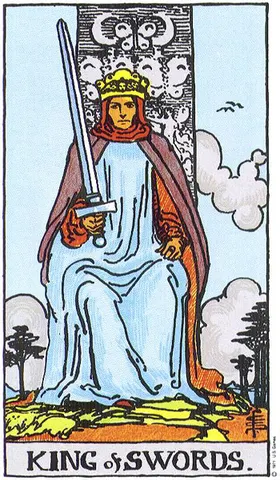
A king sits with an unsheathed sword, a figure of judgment, command, and structured thought. The King represents decisions that affect others and therefore demand reasons, limits, and accountability. Authority is most useful when it protects fair process rather than personal impulse.
Read the guideBy Moonletter · Updated
A way to read it
Upright: Judgment and responsibility
Upright, make the standard explicit before applying it. Gather relevant evidence, hear affected perspectives, and explain the decision in terms others can examine. A sound judgment can still disappoint someone; fairness depends on process, not universal approval.
A way to read it
Reversed meaning
Reversed, authority may become rigid, manipulative, or punitive, or analysis may be used to rationalize a preferred result. Invite independent review and identify who bears the consequences. A confident tone does not make a decision fair.
Love and relationships
Use these themes alongside actual communication; a card cannot establish another person’s private feelings.
If single
In dating, the King suggests direct conversation about expectations, time, or commitment. A title, professional manner, or confident advice does not guarantee emotional availability. Look for mutual respect and room to disagree rather than mistaking authority for compatibility.
In a relationship
Partners can bring structure to a recurring issue by agreeing on principles and a decision process. Avoid turning the conversation into a ruling where one person is judge and the other defendant. Share responsibility for the outcome and revisit whether the agreement works.
As feelings
As feelings, this may suggest respect, carefulness, or a preference for reasoned communication, but cannot confirm what someone privately feels. Ask what they want and notice whether conduct matches the answer. Reserve your own judgment until evidence is clearer.
Reversed in love
Reversed in love, rules or logic may be used to control the conversation or dismiss emotional impact. Ask for a mutual process where both people can speak. If intimidation or coercion is involved, a balanced debate may not be safe or appropriate.
Career and work
At work, the King suits governance, legal review, policy decisions, and clear accountability. State the decision owner, evidence base, alternatives considered, and appeal path. Good authority makes its reasoning legible and accepts correction when new facts matter.
Reversed in career
Reversed, leadership may hide behind procedure or use policy selectively. Compare how similar cases were handled and ask for independent review. Correct the process if standards were applied unevenly; authority does not remove the duty to explain.
Future position
In a future position, the King asks you to prepare for a consequential decision with transparent criteria. It predicts no legal ruling or person in authority. Gather records, consider affected parties, and identify how you will revise your view if evidence changes.
Reading the position
Treat this as a possible developing theme and look for real evidence that supports the interpretation, rather than a guaranteed event.
Yes or no
Editorially, this leans yes to a decision supported by evidence and fair procedure, no to unchecked authority or certainty without review. It cannot replace legal or professional advice. Use qualified counsel where the real stakes require it.
An editorial convention
Yes/no labels are not a universal tarot standard. This guide uses them as reflection prompts, not as factual answers or a substitute for important decisions.
Try a reflection exercise
For a decision you control, write the rule, evidence, affected people, alternatives, and reason for the final choice. Ask a person outside the decision to identify bias or missing context. Record what new evidence would justify changing course.
About this exercise
This is a Moonletter editorial exercise, not an instruction from the historical source.
Imagery and symbolism
Waite connects the King with judgment, power, command, authority, law, and offices of state; reversed, he warns of cruelty and evil intention. This modern guide emphasizes accountable authority and does not treat the card as a literal judge or legal outcome.
King of Swords vs Queen of Swords
Queen of Swords sets a personal boundary through discernment; King of Swords applies standards and judgment where decisions carry broader responsibility.
Sources and interpretation
Historical imagery is referenced against A. E. Waite’s The Pictorial Key to the Tarot, Part III (public text on Wikisource). Modern relationship and work applications and exercises are editorial interpretations. Tarot symbolism is not scientific evidence about future events or another person’s thoughts.
Take the question one step further
Bring your own context
Use this as a learning prompt about the card. It is not a real draw or a prediction.
Ask the assistantA few clear answers
Questions people ask
What does the King of Swords mean?
A king sits with an unsheathed sword, a figure of judgment, command, and structured thought. The King represents decisions that affect others and therefore demand reasons, limits, and accountability. Authority is most useful when it protects fair process rather than personal impulse.
What does the King of Swords reversed mean?
Reversed, authority may become rigid, manipulative, or punitive, or analysis may be used to rationalize a preferred result. Invite independent review and identify who bears the consequences. A confident tone does not make a decision fair.
What does the King of Swords mean in love?
Partners can bring structure to a recurring issue by agreeing on principles and a decision process. Avoid turning the conversation into a ruling where one person is judge and the other defendant. Share responsibility for the outcome and revisit whether the agreement works.
Is the King of Swords a yes or no?
Editorially, this leans yes to a decision supported by evidence and fair procedure, no to unchecked authority or certainty without review. It cannot replace legal or professional advice. Use qualified counsel where the real stakes require it.