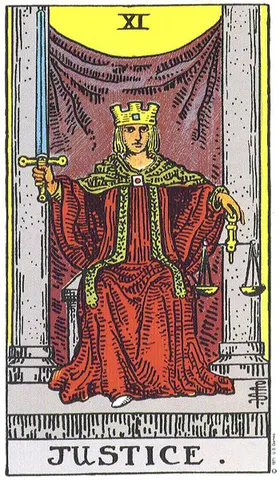
fair judgment, truth, balance, and accountability
Justice Tarot Card Meaning
Justice is traditionally associated with fair judgment, truth, balance, and accountability. Upright, it emphasizes this theme; reversed, it may point to bias, unfairness, evasion of responsibility, or a decision made without enough evidence. Treat the card as a symbolic lens, not a prediction. In a future position it offers a possible direction, not a guaranteed event.
Read the guideBy Moonletter · Updated
A way to read it
Upright: fair judgment, truth, balance, and accountability
Justice asks that a conclusion fit the evidence and that responsibility be assigned fairly. Its scales weigh competing claims; its sword cuts through an explanation that does not hold up. Upright, the card can point to a decision, an agreement or the consequences of an earlier choice. Fairness does not always mean that everyone receives the same thing.
A way to read it
Reversed: bias, unfairness, evasion of responsibility, or a decision made without enough evidence
Reversed, Justice may suggest bias, unfairness, evasion of responsibility, or a decision made without enough evidence. It need not mean the simple opposite of the upright card. Consider where the card’s theme is blocked, distorted, or avoided. The examples here are invented reflection prompts, not client cases or predictions.
Justice in love and relationships
In love readings, Justice asks whether agreements, effort and accountability are mutual. Fairness need not mean identical contributions, but both people should understand and accept the arrangement. Reversed, examine a specific double standard or an avoided responsibility before assigning blame. The card cannot establish another person’s private feelings.
If you are single
For a single reader, Justice asks whether attraction is matched by honest communication and compatible values.
If you are in a relationship
In a relationship, it brings reciprocity, boundaries, and agreements into focus.
As feelings
As a feelings card it can symbolize a wish to be fair or clear about consequences; it cannot establish private feelings.
Reversed
Reversed, check whether one person is avoiding accountability or applying a rule only to the other. Discuss a specific agreement and each person’s contribution before deciding what would be fair.
Justice in a career reading
At work, review the actual criteria, written agreements, and evidence before reaching a conclusion. Reversed, check for biased standards, omitted information, or a responsibility that needs owning.
Editorial exercise (invented)
Invented exercise: imagine teammates disagreeing about project credit; list each contribution and its evidence before suggesting a fair resolution.
Justice in a future position
Read this position as a possible direction, shaped by choices and circumstances.
Upright
In a future position, Justice may point to a decision, review, contract, or conversation where facts and consequences matter. Prepare records and ask precise questions; the card does not guarantee a favorable ruling.
Reversed
Reversed, an uneven decision or unaddressed responsibility may need attention.
Read the conditions
Identify one condition that would support this direction and one observable sign that would show whether it is developing. The card does not set a date.
Is Justice a yes or no?
Yes/no readings use shorthand conventions, not factual forecasts.
A common convention
Upright can lean “yes, if fair and supported by facts”; reversed says “pause and check bias, evidence, and accountability.” It cannot predict a court result.
Before deciding
For consequential choices, check the evidence, consent, written terms, or practical conditions the decision requires.
Justice symbolism
The seated figure holds scales and an upright sword. The scales suggest weighing competing claims; the sword suggests clear judgment and consequence. In Waite’s sequence this is XI. The image is a reflection prompt, not a guarantee of legal justice. Image details vary by deck. Historical references below document a tradition, not predictive validity.
Justice or The Lovers?
Justice emphasizes fair judgment, truth, balance, and accountability; The Lovers instead focuses on a personal choice guided by values. The distinction helps ask different questions of the spread; it does not predict an outcome.
Interpretation and sources
Historical image descriptions can be compared with A. E. Waite’s The Pictorial Key to the Tarot. The relationship, career, yes/no and exercise sections are Moonletter editorial interpretations, not claims from a scientific study or guarantees about events.
Take the question one step further
Bring your own context
Use this as a learning prompt about the card. It is not a real draw or a prediction.
Ask the assistantA few clear answers
Questions people ask
What does Justice mean upright?
Fair judgment, balance, truth, and responsibility for a choice.
What does reversed Justice suggest?
Possible bias, unequal treatment, missing facts, or avoiding accountability.
What does Justice mean in love?
It asks whether communication, boundaries, and agreements are reciprocal.
Does Justice predict a court result?
No. Actual outcomes depend on evidence and the legal process.
Is Justice yes or no?
Upright may lean yes when a choice is fair and evidence-based; reversed asks you to investigate an imbalance.
What advice does the Justice card offer?
Check the facts, make your standards explicit and take responsibility for your part. Before a difficult conversation, separate what you observed from what you assumed, then ask what agreement each person understood. Fairness may require revising an arrangement, not simply assigning blame.