attachment, temptation, power, and habits that narrow choice
The Devil Tarot Card Meaning
The Devil is traditionally associated with attachment, temptation, power, and habits that narrow choice. Upright, it emphasizes this theme; reversed, it may point to denial, coercive influence, or recognizing an attachment and beginning to break free. Treat the card as a symbolic lens, not a prediction. In a future position it offers a possible direction, not a guaranteed event.
Read the guideBy Moonletter · Updated
A way to read it
Upright: attachment, temptation, power, and habits that narrow choice
The Devil brings attention to a bond that is compelling but constraining. Attraction, approval, status or immediate reward may make a pattern difficult to question. Upright, it asks what the attachment provides and what freedom it costs. It does not label a person evil. In a coercive situation, responsibility lies with the person exerting control; a card is not a reason to blame yourself.
A way to read it
Reversed: denial, coercive influence, or struggle to loosen a bond
Reversed, The Devil can suggest denial or coercive influence, but it may also mark recognizing an attachment and beginning to break free. It need not mean the simple opposite of the upright card. Look at what choice, support, or boundary could restore room to act. The examples here are invented prompts, not client cases or predictions.
The Devil in love and relationships
In love readings, the Devil can symbolize strong attraction, dependence or unequal power. Attraction alone is not the same as a harmful dynamic: consider whether each person can express a boundary and make choices without pressure. Reversed may invite reflection on loosening an unhelpful attachment, but change can require practical support. The card is not evidence of cheating or proof of someone’s private intentions.
If you are single
For a single reader, the Devil asks whether chemistry is being mistaken for compatibility or a repeating pattern is steering choices.
If you are in a relationship
In a relationship, it highlights jealousy, unequal power, secrecy, or a habit worth naming.
As feelings
As a feelings card it may symbolize intense desire or fixation, not diagnose someone or prove their emotions.
Reversed
Reversed, some readers see recognition or an opening to loosen an attachment.
The Devil in a career reading
At work, ask what keeps you tied to a role: real obligation, fear of losing status, short-term reward, or eroded boundaries. It does not mean a workplace is evil. Reversed, seek a practical way to regain choice.
Editorial exercise (invented)
Invented exercise: imagine someone accepting every late request to seem indispensable; list reward, cost, and one boundary to test.
The Devil in a future position
Read this position as a possible direction, shaped by choices and circumstances.
Upright
In a future position, this card may warn that an enticing pattern could gain influence if left unexamined. It does not mean you are doomed.
Reversed
Reversed, awareness may create room for a different choice.
Read the conditions
Identify one condition that would support this direction and one observable sign that would show whether it is developing. The card does not set a date.
Is The Devil a yes or no?
Yes/no readings use shorthand conventions, not factual forecasts.
A common convention
The Devil is not a default yes. Upright usually calls for caution about attachment or costly temptation; reversed may suggest loosening a bond.
Before deciding
For consequential choices, check the evidence, consent, written terms, or practical conditions the decision requires.
The Devil symbolism
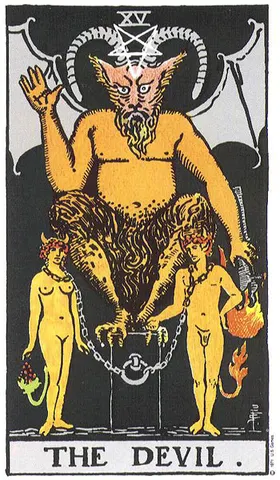
A horned figure presides over two people attached by loose chains. The image raises questions about desire and constraint; it does not label anyone evil or imply that change is easy. Image details vary by deck. Historical references below document a tradition, not predictive validity.
The Devil or The Lovers?
The Devil emphasizes attachment, temptation, power, and habits that narrow choice; The Lovers instead focuses on a conscious choice guided by values. The distinction helps ask different questions of the spread; it does not predict an outcome.
Interpretation and sources
Historical image descriptions can be compared with A. E. Waite’s The Pictorial Key to the Tarot. The relationship, career, yes/no and exercise sections are Moonletter editorial interpretations, not claims from a scientific study or guarantees about events.
Take the question one step further
Bring your own context
Use this as a learning prompt about the card. It is not a real draw or a prediction.
Ask the assistantA few clear answers
Questions people ask
What does the Devil mean upright?
Attachment, temptation, or a pattern that may narrow choice.
What does reversed Devil mean?
It can mean recognizing an attachment and beginning to break free from a habit or bond.
What does it mean in love?
It can raise questions about desire, jealousy, secrecy, or unequal power; it cannot diagnose a partner.
Is the Devil a yes or no?
Not a default yes; it calls for caution about the nature and cost of attachment.
Does this mean I am trapped?
No. Examine constraints and choices; difficult situations may also require real-world support.
Does the Devil card mean someone is cheating?
No. The Devil card cannot establish whether someone is cheating. Its themes of attraction, attachment and power can prompt reflection on trust and boundaries, but an accusation needs real evidence. Discuss concrete concerns without presenting a card as proof.