integration, measured adjustment, and a workable middle course
Temperance Tarot Card Meaning
Temperance is traditionally associated with integration, measured adjustment, and a workable middle course. Upright, it emphasizes this theme; reversed, it may point to excess, impatience, clashing interests, or imbalance. Treat the card as a symbolic lens, not a prediction. In a future position it offers a possible direction, not a guaranteed event.
Read the guideBy Moonletter · Updated
A way to read it
Upright: integration, measured adjustment, and a workable middle course
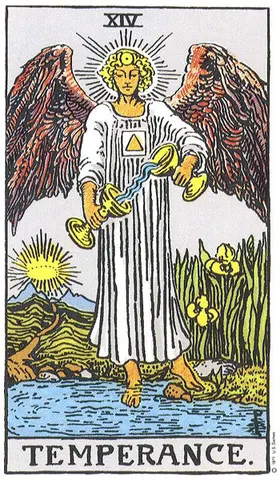
Temperance brings different elements into a workable relationship. The flowing cups suggest adjustment rather than a rigid halfway point: sometimes one ingredient needs more space than another. Upright, it favors patience, integration and a rhythm that can be sustained. The question is how the parts can work together without erasing their differences.
A way to read it
Reversed: excess, impatience, clashing interests, or imbalance
Temperance reversed can symbolize excess, impatience, competing priorities or an arrangement that asks one person to do all the adjusting. Identify what is out of proportion: pace, workload, expectations or willingness to compromise. A useful response may be to slow one commitment, clarify a limit or test a smaller change. Balance does not require splitting every difference or accepting an unfair arrangement.
Temperance in love and relationships
In love readings, Temperance emphasizes patience, cooperation and a rhythm that works for both people. It invites you to combine different needs without erasing either person’s boundaries. Reversed, check whether one person repeatedly accommodates the other or whether expectations about contact and commitment clash. The card cannot establish that someone is your soulmate or confirm private feelings.
If you are single
For a single reader, Temperance favors a pace that lets trust develop through repeated, low-pressure contact.
If you are in a relationship
In a relationship, it can describe blending different needs without asking one person to disappear.
As feelings
As a feelings card it may suggest calm interest or a wish for common ground, but cannot confirm private feelings.
Reversed
Reversed, check whether only one person keeps adjusting.
Temperance in a career reading
In career readings, Temperance emphasizes combining skills, people and resources at a sustainable pace. When teams use different processes, agree on one shared handoff and test it before changing everything. Reversed, distinguish too many commitments from conflicting priorities: one may call for reducing workload, the other for clarifying which goal comes first. Cooperation does not mean accepting every request.
Editorial exercise (invented)
Invented exercise: imagine two teams combining weekly reports; test a shared format briefly and ask both what improved before making it permanent.
Temperance in a future position
Read this position as a possible direction, shaped by choices and circumstances.
Upright
In a future position, Temperance suggests gradual coordination through pacing and adjustment, not instant peace.
Reversed
Reversed, competing demands may call for a limit or redesign rather than more effort.
Read the conditions
Identify one condition that would support this direction and one observable sign that would show whether it is developing. The card does not set a date.
Is Temperance a yes or no?
Yes/no readings use shorthand conventions, not factual forecasts.
A common convention
Upright can lean “yes, with patience and proportion”; reversed, “not in the current mix—adjust the conditions.”
Before deciding
For consequential choices, check the evidence, consent, written terms, or practical conditions the decision requires.
Temperance symbolism
An angel pours liquid between two cups, one foot on land and one in water; a path leads toward light. The image suggests exchange between different states. Waite includes moderation and accommodation among its historical associations. Image details vary by deck. Historical references below document a tradition, not predictive validity.
Temperance or The Star?
Temperance emphasizes integration, measured adjustment, and a workable middle course; The Star instead focuses on renewal and replenishment. The distinction helps ask different questions of the spread; it does not predict an outcome.
Interpretation and sources
Historical image descriptions can be compared with A. E. Waite’s The Pictorial Key to the Tarot. The relationship, career, yes/no and exercise sections are Moonletter editorial interpretations, not claims from a scientific study or guarantees about events.
Take the question one step further
Bring your own context
Use this as a learning prompt about the card. It is not a real draw or a prediction.
Ask the assistantA few clear answers
Questions people ask
What does Temperance mean upright?
Moderation, integration, and combining needs at a workable pace.
What does reversed Temperance mean?
Excess, impatience, competing priorities, or one-sided compromise.
What does it mean in love?
Patient cooperation and a pace that feels workable to both.
What does it mean for career?
Collaboration and gradual improvement rather than abrupt overhaul.
Is it yes or no?
Upright leans yes with patience; reversed asks you to adjust conditions first.
Does Temperance mean someone is my soulmate?
No card can establish that someone is your soulmate. Temperance can be used to reflect on compatibility, patience and reciprocal adjustment. Look for consistent communication, respected boundaries and willingness from both people; calm symbolism is not proof that a relationship is destined to last.