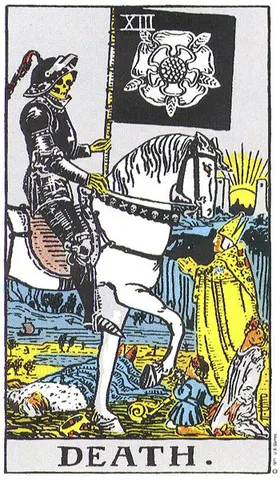
an ending, transition, and clearing away what has run its course
Death Tarot Card Meaning
Death is traditionally associated with an ending, transition, and clearing away what has run its course. Upright, it emphasizes this theme; reversed, it may point to resistance to change, prolonged endings, or difficulty releasing an old pattern. Treat the card as a symbolic lens, not a prediction. In a future position it offers a possible direction, not a guaranteed event.
Read the guideBy Moonletter · Updated
A way to read it
Upright: an ending, transition, and clearing away what has run its course
Death describes an ending that changes the shape of what follows. It can mean releasing a role, routine or expectation that has run its course, with room for grief as well as renewal. Upright, it emphasizes transition rather than preserving everything unchanged. The card is not a reliable signal of physical death or illness.
A way to read it
Reversed: resistance to change, prolonged endings, or difficulty releasing an old pattern
Reversed, Death may suggest resistance to change, prolonged endings, or difficulty releasing an old pattern. It need not mean the simple opposite of the upright card. Consider where the card’s theme is blocked, distorted, or avoided. The examples here are invented reflection prompts, not client cases or predictions.
Death in love and relationships
In love readings, Death can symbolize the end of a familiar pattern, a relationship stage, or the relationship itself. These are different possibilities: retiring an unhelpful habit is not the same as separating. Identify what has actually changed and what both people want to carry forward. The card cannot decide whether you should break up or reveal another person’s feelings.
If you are single
For a single reader, Death may mean leaving an old relationship pattern behind, not predicting a new partner.
If you are in a relationship
In a relationship, it can describe a changed routine, renegotiated roles, or a chapter that has ended.
As feelings
As a feelings card it can symbolize a changed attitude or wish to close a chapter; it cannot confirm another person’s feelings. This card does not mean physical death.
Reversed
Reversed, a relationship may be trying to preserve an old pattern despite changed needs. Discuss what needs to end or change; the card alone cannot decide whether the relationship should continue.
Death in a career reading
At work, Death can represent finishing a role, project, or method so another phase can begin; it is not a forecast of job loss. Identify what is ending and what must be handed over. Reversed, an outdated process may be kept alive.
Editorial exercise (invented)
Invented exercise: imagine a team retiring a report; record what it taught them and what replaces it.
Death in a future position
Read this position as a possible direction, shaped by choices and circumstances.
Upright
In a future position, Death suggests a meaningful transition may be underway. Ask what is ready to conclude and what needs a clean handoff. It does not predict a breakup, illness, bereavement, or specific event.
Reversed
Reversed, fear may be prolonging change.
Read the conditions
Identify one condition that would support this direction and one observable sign that would show whether it is developing. The card does not set a date.
Is Death a yes or no?
Yes/no readings use shorthand conventions, not factual forecasts.
A common convention
Upright says “yes to necessary change”; reversed, “not until resistance or unfinished business is addressed.” Never read it as literal death.
Before deciding
For consequential choices, check the evidence, consent, written terms, or practical conditions the decision requires.
Death symbolism
A skeletal rider crosses a scene of varied human responses, with a sun rising between distant towers. The image joins ending with passage toward a new horizon. Waite’s historical keywords include ending and transformation; the card does not predict mortality. Image details vary by deck. Historical references below document a tradition, not predictive validity.
Death or The Tower?
Death emphasizes an ending, transition, and clearing away what has run its course; The Tower instead focuses on sudden rupture and collapse of a structure. The distinction helps ask different questions of the spread; it does not predict an outcome.
Interpretation and sources
Historical image descriptions can be compared with A. E. Waite’s The Pictorial Key to the Tarot. The relationship, career, yes/no and exercise sections are Moonletter editorial interpretations, not claims from a scientific study or guarantees about events.
Take the question one step further
Bring your own context
Use this as a learning prompt about the card. It is not a real draw or a prediction.
Ask the assistantA few clear answers
Questions people ask
Does Death mean literal death?
No. It is read symbolically as ending and transition, not physical death.
What does Death upright mean?
A chapter may be ending so change can follow.
What does reversed Death mean?
Resistance or delay in completing a transition.
What does Death mean in love?
It may describe changing a relationship pattern or closing a chapter; it cannot decide whether a couple will separate.
Is Death yes or no?
It tends to say yes to necessary change, not to a specific event.
Does repeatedly drawing Death mean something bad will happen?
No. Repeatedly drawing Death does not establish that an event will happen. You can use its symbolism to reflect on an unfinished transition or a habit you are reluctant to release, but repetition is not evidence of danger. Check what is actually changing rather than treating the card as a warning.